Monday, January 28, 2008

"Why we are supporting Barack Obama"

Andrew Villeneuve and Scott Gifford (NPI blog):
We are Obama fans.
Like Markos, we would happily support any of the three major candidates, each of whom, we believe, could defeat whoever the Republicans throw at us.

Senator Clinton is a determined leader and brings with her a tremendous amount of intellectual gravitas. Senator Edwards speaks knowledgeably and forcefully about the challenges that face most American families - such as wage stratification, healthcare, or making college affordable.

But Barack Obama is the only candidate of the three who is talking about transformative, sweeping change. Not just a change in who runs the executive branch, but a visible, meaningful change in our politics and our culture.

Change that casts aside apathy, conflict, and cynicism in favor of fresh energy, harmony, and renewed hope for the United States of America.

Perhaps because he is such a gifted communicator, he speaks the plain language of real American values more masterfully than his rivals.

Obama has inspired a breathtaking number of young people across America - the generation whose participation is critical to the future of our democracy - to care about our nation's political process and become involved with his campaign.

We have been impressed with the responsiveness of the Obama campaign firsthand. Earlier this month, we inquired as to Barack Obama's position on transportation and livable communities - a topic that doesn't receive much attention in the traditional media. We promptly received a comprehensive paper outlining Obama's support for Amtrak, for municipal rapid transit and light rail, for a stronger air traffic control system, and for livable, walkable communities.

And then, when we had a couple of very specific follow-up questions, Obama's team tried their best to answer those for us as well.

Barack is a strong and charismatic leader capable of rallying our nation together... and building a powerful Democratic Party, as Roosevelt and Kennedy did. He is a candidate that Americans feel they can trust. Someone we can identify with, as Caroline Kennedy declared so eloquently in her New York Times column today.

If the Clinton and Bush years have taught us anything, it is that narrow (and illegitimate) victories are often somewhat pyrrhic. President Bill Clinton, for example, held many positions that were hardly progressive (don’t ask don’t tell, welfare cutbacks, and the "Defense of Marriage Act", to name a few).

Clinton governed well, considering the hostile Republican Congress he had to contend with for most of his presidency. But he was unable to advance the progressive cause and be the shepard of dramatic, transcendental change.

And George W. Bush...well, don't even get us started. The rampant destruction Bush and his cronies have caused will forever be a remembered as a tragic era error in our nation's history.

Compare Bush and Clinton to Ronald Reagan, revered as a saint among conservatives and held in fond regard by many biconceptuals (or independents) as well. Reagan cleverly championed individualism and advanced the right wing agenda as president. He won reelection decisively over Mondale in 1984 and spent much of the decade quietly dismantling the work of Lyndon Johnson and Jimmy Carter.

Much as we dislike and disagree with Reagan's views, we have to admit that he did an outstanding job of winning Americans to his side. He sought to move voters to embrace his worldview, rather than sacrificing his beliefs in an attempt to get support. He even persuaded Americans who did not agree with his conservative views to vote for him. And that's the kind of power that Barack Obama has.

In recent decades, Democratic candidates have unfortunately come to rely on polling and focus groups to determine the direction of their campaigns.

This is a self-defeating move. The job of leaders is to lead, not to follow.

Following the voters may make sense if you desperately want to capture the White House, as Hillary Clinton does. Barack Obama's campaign, in contrast, is about growing the Democratic Party and building the progressive movement. Movement building requires communication, framing, connecting, and engaging in politics in its truest and most traditional sense.

The word politic is from Latin or Greek. It refers to matters that pertained to citizens or the state; the body politic. Politics is the science or study of how to best govern, not simply how to win elected office. While winning is important, it is only important as a necessary condition for the true aim of politics, to create good public policy for the betterment of the nation.

It’s about inspiring Americans to see that they can be better, and to see progressive ideas as the key to improving this country.

It's not just about restoring America's promise. It's the true advancement, in every dimension, of the values our country was founded upon and has always stood for.

Hillary Clinton and John Edwards may have their own unique strengths, but neither has Barack Obama's extroadinarily compelling emotional message or diverse, widespread appeal. As the nominee - the Democratic standard bearer - Obama would benefit more from having Edwards and Clinton at his side than Clinton or Edwards would benefit from having Obama at their side.

Why? Because the theme of Obama's candidacy, which resonates both inside and outside the Democratic Party, is a new, unifying progressive politics for America. Clinton, on the other hand, is the darling of the Democratic establishment, while Edwards is a confrontational populist who justifiably wants to fight back against corporate greed and degradation of our common wealth.

We admire Edwards' resolve and passion for fighting the good fight. But America needs more than that at this critical moment, at this crossroads in time.

Healing the harm caused to this country through years of a divisive "you're either with us or you're against us" administration will take courageous and patient leadership from an authentic, pragmatic Democrat. It will take a Commander in Chief who can move this country forward by making it nearly impossible for Republicans to choose not to compromise.

We believe Barack Obama will be that President.

"The Billary Road to Republican Victory"

Frank Rich (NY Times):
IN the wake of George W. Bush, even a miracle might not be enough for the Republicans to hold on to the White House in 2008. But what about two miracles? The new year’s twin resurrections of Bill Clinton and John McCain, should they not evaporate, at last give the G.O.P. a highly plausible route to victory.
Amazingly, neither party seems to fully recognize the contours of the road map. In the Democrats’ case, the full-throttle emergence of Billary, the joint Clinton candidacy, is measured mainly within the narrow confines of the short-term horse race: Do Bill Clinton’s red-faced eruptions and fact-challenged rants enhance or diminish his wife as a woman and a candidate?

Absent from this debate is any sober recognition that a Hillary Clinton nomination, if it happens, will send the Democrats into the general election with a new and huge peril that may well dwarf the current wars over race, gender and who said what about Ronald Reagan.

What has gone unspoken is this: Up until this moment, Hillary has successfully deflected rough questions about Bill by saying, “I’m running on my own” or, as she snapped at Barack Obama in the last debate, “Well, I’m here; he’s not.” This sleight of hand became officially inoperative once her husband became a co-candidate, even to the point of taking over entirely when she vacated South Carolina last week. With “two for the price of one” back as the unabashed modus operandi, both Clintons are in play.

For the Republicans, that means not just a double dose of the one steroid, Clinton hatred, that might yet restore their party’s unity but also two fat targets. Mrs. Clinton repeatedly talks of how she’s been “vetted” and that “there are no surprises” left to be mined by her opponents. On the “Today” show Friday, she joked that the Republican attacks “are just so old.” So far. Now that Mr. Clinton is ubiquitous, not only is his past back on the table but his post-presidency must be vetted as well. To get a taste of what surprises may be in store, you need merely revisit the Bill Clinton questions that Hillary Clinton has avoided to date.

Asked by Tim Russert at a September debate whether the Clinton presidential library and foundation would disclose the identities of its donors during the campaign, Mrs. Clinton said it wasn’t up to her. “What’s your recommendation?” Mr. Russert countered. Mrs. Clinton replied: “Well, I don’t talk about my private conversations with my husband, but I’m sure he’d be happy to consider that.”

Not so happy, as it turns out. The names still have not been made public.

Just before the holidays, investigative reporters at both The Washington Post and The New York Times tried to find out why, with no help from the Clintons. The Post uncovered a plethora of foreign contributors, led by Saudi Arabia. The Times found an overlap between library benefactors and Hillary Clinton campaign donors, some of whom might have an agenda with a new Clinton administration. (Much as one early library supporter, Marc Rich’s ex-wife, Denise, had an agenda with the last one.) “The vast scale of these secret fund-raising operations presents enormous opportunities for abuse,” said Representative Henry Waxman, the California Democrat whose legislation to force disclosure passed overwhelmingly in the House but remains stalled in the Senate.

The Post and Times reporters couldn’t unlock all the secrets. The unanswered questions could keep them and their competitors busy until Nov. 4. Mr. Clinton’s increased centrality to the campaign will also give The Wall Street Journal a greater news peg to continue its reportorial forays into the unraveling financial partnership between Mr. Clinton and the swashbuckling billionaire Ron Burkle.

At “Little Rock’s Fort Knox,” as the Clinton library has been nicknamed by frustrated researchers, it’s not merely the heavy-hitting contributors who are under wraps. Even by the glacial processing standards of the National Archives, the Clintons’ White House papers have emerged slowly, in part because Bill Clinton exercised his right to insist that all communications between him and his wife be “considered for withholding” until 2012.

When Mrs. Clinton was asked by Mr. Russert at an October debate if she would lift that restriction, she again escaped by passing the buck to her husband: “Well, that’s not my decision to make.” Well, if her candidacy is to be as completely vetted as she guarantees, the time for the other half of Billary to make that decision is here.

The credibility of a major Clinton campaign plank, health care, depends on it. In that same debate, Mrs. Clinton told Mr. Russert that “all of the records, as far as I know, about what we did with health care” are “already available.” As Michael Isikoff of Newsweek reported weeks later, this is a bit off; he found that 3,022,030 health care documents were still held hostage. Whatever the pace of the processing, the gatekeeper charged with approving each document’s release is the longtime Clinton loyalist Bruce Lindsey.

People don’t change. Bill Clinton, having always lived on the edge, is back on the precipice. When he repeatedly complains that the press has given Mr. Obama a free ride and over-investigated the Clintons, he seems to be tempting the fates, given all the reporting still to be done on his post-presidential business. When he says, as he did on Monday, that “whatever I do should be totally transparent,” it’s almost as if he’s setting himself up for a fall. There’s little more transparency at “Little Rock’s Fort Knox” than there is at Giuliani Partners.

“The Republicans are not going to have any compunctions about asking anybody anything,” Mrs. Clinton lectured Mr. Obama. Maybe so, but Republicans are smart enough not to start asking until after she has secured the nomination.

Not all Republicans are smart enough, however, to recognize the value of John McCain should Mrs. Clinton emerge as the nominee. He’s a bazooka aimed at most every rationale she’s offered for her candidacy.

In a McCain vs. Billary race, the Democrats will sacrifice the most highly desired commodity by the entire electorate, change; the party will be mired in déjà 1990s all over again. Mrs. Clinton’s spiel about being “tested” by her “35 years of experience” won’t fly either. The moment she attempts it, Mr. McCain will run an ad about how he was being tested when those 35 years began, in 1973. It was that spring when he emerged from five-plus years of incarceration at the Hanoi Hilton while Billary was still bivouacked at Yale Law School. And can Mrs. Clinton presume to sell herself as best equipped to be commander in chief “on Day One” when opposing an actual commander and war hero? I don’t think so.

Foreign policy issue No. 1, withdrawal from Iraq, should be a slam-dunk for any Democrat. Even the audience at Thursday’s G.O.P. debate in Boca Raton cheered Ron Paul’s antiwar sentiments. But Mrs. Clinton’s case is undermined by her record. She voted for the war, just as Mr. McCain did, in 2002 and was still defending it in February 2005, when she announced from the Green Zone that much of Iraq was “functioning quite well. ” Only in November 2005 did she express the serious misgivings long pervasive in her own party. When Mr. McCain accuses her of now advocating “surrender” out of political expediency, her flip-flopping will back him up.

Billary can’t even run against the vast right-wing conspiracy if Mr. McCain is the opponent. Rush Limbaugh and Tom DeLay hate Mr. McCain as much as they hate the Clintons. And they hate him for the same reasons Mr. McCain wins over independents and occasional Democrats: his sporadic (and often mild) departures from conservative orthodoxy on immigration and campaign finance reform, torture, tax cuts, climate change and the godliness of Pat Robertson. Since Mr. McCain doesn’t kick reporters like dogs, as the Clintons do, he will no doubt continue to enjoy an advantage, however unfair, with the press pack on the Straight Talk Express.

Even so, Mr. McCain hasn’t yet won a clear majority of Republican voters in any G.O.P. contest. He’s depended on the kindness of independent voters. Tuesday’s Florida primary, which is open exclusively to Republicans, is his crucial test. If he fails, his party remains in chaos and Mitt Romney could still inherit the earth.

That would be a miracle for the Democrats, but they can hardly count on it. If Mr. Obama has not met an unexpected Waterloo in South Carolina — this column went to press before Saturday’s vote — the party needs him to stop whining about the Clintons’ attacks, regain his wit and return to playing offense. Unlike Mrs. Clinton, he would unambiguously represent change in a race with any Republican. If he vanquishes Billary, he’ll have an even stronger argument to take into battle against a warrior like Mr. McCain.

If Mr. Obama doesn’t fight, no one else will. Few national Democratic leaders have the courage to stand up to the Clintons. Even in defeat, Mr. Obama may at least help wake up a party slipping into denial. Any Democrat who seriously thinks that Bill will fade away if Hillary wins the nomination — let alone that the Clintons will escape being fully vetted — is a Democrat who, as the man said, believes in fairy tales.

"Yes, the Power of Honesty."

icebergslim's diary on Kos, "Why the young are inspired by Obama? And why the Democratic Party needs to embrace them":


clemson university, south carolina

Yes, Barack Obama won South Carolina, handily. Not just by a few points, but 28 points. We all know a lot of things factored in that win, but the biggest deciding factor was that folk are tired of race baiting politics, and it just did not WORK.

But, let us focus on something else.

I had family and friends over last night for a SC Watch Party. Right when we thought we were about to hunker down for the results, well, the primary was called immediately for Barack.

Well, we looked at each other, laughed and went back and forth on what really happened. Anyway, I thought about something a friend of mine told me as the night progressed, as Caroline Kennedy's endorsement was announced. About how the young have been solidly behind Obama's candidacy. How the young, even the ones not of voting age had grabbed onto this campaign and are solidly, committed.

As I read Caroline Kennedy's endorsement, I thought back on Senator Claire McCaskill and her description of what made her come out and support Barack Obama. She explained that as she watched the Iowa results with her daughter it was her daughter who said, "Mom, how can you not endorse him. You have to."

As I spoke with my friend last night and read the eloquent words of Caroline Kennedy's "A President Like My Father", the conversation went along the lines of why did Caroline endorse Barack? I know she was a Hillary supporter, but what made her embrace Obama.

Many scenarios were discussed, but we ended up with this one. Her children. Just as Claire, it was Caroline's children.

Children. Kids. The Young. The Youth. Whatever, we call them are instrumental in making our parents, elders, neighbors and friends, look and listen to what Barack Obama have to say. Whether we like it or not, whether we disagree or not, no other candidate in the Democratic Party is exciting or have the youth energized about possiblities, as Barack Obama.

Which brings me to Populista.

Populista is a 14 year old kid, who writes eloquent, positive diaries about Barack Obama.

When you read Populista, you are in awe, but when you find out 14 years old, you are stunned. The first question that came to my mind is why? What is connecting with teenagers across this country with Barack Obama? I asked my 18 year old niece, a senior in high school who is caucusing for Obama in Minnesota, I asked her, "What is it about Obama that makes you listen to him?" She simply said, "I believe what he says. He is honest." Yes, the Power of Honesty.

One thing about the young is that they don't have time for fakeness, crap or B.S. Their attention span is ten seconds, so if you have something to say, you better grab them. Barack Obama has done that. Now we see our youth, wanting to believe in their government, possiblity, hope for the future, working for the campaign, blogging, text messaging, etc. It can only be the candor and honesty of Barack Obama to move them, and it is just that.

What we saw in Iowa and South Carolina was the infusion of the young vote. Something the other Democratic Candidates don't have, but must need to win in November.

This is an infectious time and an exciting time. This is also the first time we are witnessing the young coming out solidly in droves for Barack Obama, all across the country.

Populista is like millions of kids out here who have caught onto what Barack Obama is about. A sheer testament to the power of the youth. No more comments like, "they look like facebook caucus goers", for the Democratic Party, we need all the Populista's in our party that we can get.

Populista, you are one of my diary heros. Thank you.

::

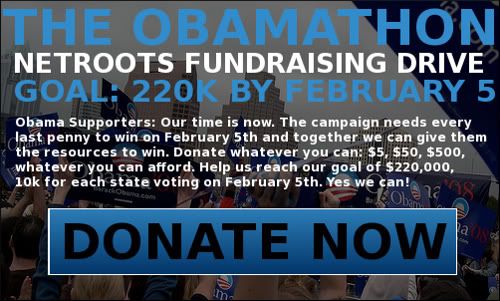
Below is the Obamathon Fundraiser, powered by Populista. If you have not given, now is the time. Let's help the future member of the Democratic Party out and donate.

Howie P.S.: I must confess I was astonished to learn that Populista is 14 years old, even though I was younger than that myself when I started doorbelling and working on campaigns.

"OBAMA DOUBLES DOWN ON YOUTUBE" (with video)

Ari Melber (The Nation), with video:
Barack Obama shattered YouTube records last week with a speech that shot past Britney Spears as one of the most watched videos of the day, drawing over half a million views in total. A new video of his South Carolina victory speech was the fifth most watched video in the world on Sunday, drawing a whopping 180,000 views in its first day online. It was also the most "favorited" clip in English. The 17-minute speech, which was far more popular than any other political clips, currently trails a Japanese animation video and a shot of actress Charlotte Ross appearing partially nude on NYPD Blue, (which earned ABC a $1.4 million fine from the FCC in 2003).

Some commentators say the only drawback to Obama's stirring speeches is that most voters don't see them. The Atlantic's Matthew Yglesias found this weekend's victory speech "doubly-impressive," for example, but worried that while such addresses "are quite well-known among political junkies, most voters have almost certainly never sat and watched him deliver one." It looks like that could change via YouTube.


Howie P.S.: Ari says "You can see more YouTube stats at TechPresident."

Sunday, January 27, 2008

"Video: Barack Obama on ABC’s This Week with George Stephanopoulos, January 27, 2008"


Part 1

Part 2

Part 3

"Obama and Clinton's State of Surveillance"

Ari Melber (The Nation):
President Bush is now daring Congress to defy his demand for more unchecked power to spy on Americans without warrants, vowing to veto temporary surveillance legislation and politicize his last State of the Union address for an attack on Democrats. Last week, Democratic leaders were considering a bill to grant a one-month extension of the administration's spying powers, a "compromise" tilted in Bush's favor, but Republican tactics have finally tried the patience of Majority Leader Harry Reid. He had been managing floor votes to advance the Republican bill and squash opposition from the majority of Democrats within his caucus, but that may change this week.
"The White House threat to veto a short extension of the Protect America Act is shamefully irresponsible," says Reid, who also derided Bush's new threat as simply "posturing" for the State of the Union. Reid added that if any terror-related problems were caused by legislative delays, "the blame will clearly and unequivocally fall where it belongs: on President Bush and his allies in Congress."

That's tough talk. It has not been matched by action yet, and unfortunately it does not add up anyway. While most Congressional Democrats have begun confronting Bush's unconstitutional demands, a few leaders like Reid and Intelligence Chair Jay Rockefeller are actually the ones pushing the Bush spying bill. That's the problem with Reid's new complaint.

At this point, Bush's "allies in Congress" on surveillance include Reid and Rockefeller. It may be hard to tell -- since Bush is repaying them with "shameful" attacks, as Reid said -- but they sidelined the more responsible spying bill to help Bush last week. (The "Leahy alternative" was backed by most Senate Democrats, and is closer to a Democratic bill that already passed the House.) Even with Reid pulling strings for Bush, Senate Democrats only fell four votes short of keeping the better bill alive. And they were missing two votes from their colleagues on the campaign trail, Barack Obama and Hillary Clinton.

Yet even Obama and Clinton are back in town for a night of pomp and rhetoric at the State of the Union. They both talk about "change" and "results" -- and here's a chance to act on it. It will take more than a speech or a vote to stop Bush's bill, though, it will take leadership. That means confronting the people who are wrong in both parties -- an (unpopular) President and the floor manager of an (unpopular) Congress -- to stop amnesty and the blueprint for a surveillance state. It's also what many Democratic voters want to see. The grassroots group Democracy for America (DFA) is running a full page ad in Monday's Times pressing Obama and Clinton, while the netroots is pleading with Senators to defend the "rule of law."

And what, exactly, can they do? I see three major options:

1. Use their influence and political capital to recruit two more votes for the Leahy bill. That's all Leahy, Feingold and Dodd need to keep their fight alive under the current rules. Obama and Clinton were endorsed by a total of seven senators who voted the wrong way last week. As DFA explains, "if these presidential hopefuls bring along the support of these senators, they can sustain a planned filibuster [and] defeat any cloture vote."

2. Use their influence and political capital to press Reid to run the floor for the Leahy bill, instead of the Bush-Rockefeller bill. This is is tough for several reasons, but there's an opening now that Bush has essentially slapped Reid around and drawn some rhetorical pushback.

3. Rally the Democratic Congress to confront Bush's veto threat. Send the one-month bill to his desk and let this unpopular president remind the entire country of his irresponsible, cynical approach to governing. Maybe his approval ratings will drop into the teens like his Vice President. (I personally favor this third option the least, since it involves gamesmanship instead of a long-term policy, which Leahy's bill offers.)

Or they could channel Harry Reid, complaining about Bush while essentially allowing him to win again.

"Kennedy to Endorse Obama"

The Caucus (NY Times political blog): MACON, Ga. – Senator Edward M. Kennedy intends to endorse the presidential candidacy of Senator Barack Obama during a rally on Monday in Washington.
The Kennedy endorsement has been underway for days, even before the outcome of the South Carolina primary. Mr. Kennedy told his decision to Mr. Obama on Thursday.

“I’ve had ongoing conversations with Ted since I’ve got into this race,” Mr. Obama told reporters today as he flew to Alabama.

Of all the endorsements in the Democratic Party, Mr. Kennedy’s is viewed as the most weighty. He had vowed to stay out of the presidential nominating fight, but as the contest expands into a state-by-state fight – and given the tone of the race in the last week – associates said he was moved to announce his support for Mr. Obama.

The endorsement will be announced at a rally at American University on Monday, hours before the State of the Union Address at the Capitol.

Mr. Obama flew to Georgia for his first post-South Carolina stop. Before appearing at Sunday morning church services at the Harvest Cathedral in Macon, Ga., Mr. Obama was asked about Mr. Kennedy’s potential endorsement on ABC News’ “This Week.”

“Well, you know, I’ll let Ted Kennedy speak for himself. And nobody does it better,” Mr. Obama said. “But obviously, any of the Democratic candidates would love to have Ted Kennedy’s support. And we have certainly actively sought it. And you know, I will let him make his announcement and his decision when he decides it’s appropriate.”

Mr. Kennedy, the latest in a string of senators to announce their support for Mr. Obama, is said by associates to be drawn to Mr. Obama because of his ability to motivate a new generation of Democrats. His niece, Caroline Kennedy, made a similar argument in an op-ed piece in today’s Times.

During Mr. Obama’s three years in the Senate, he has worked to build allies and gain friendships with many of his colleagues. While Mr. Kennedy and Mr. Obama have not been particularly close, Mr. Obama quickly gained the admiration of the Kennedy family.

It was on a November day in 2005, near the end of Mr. Obama’s first year in the Senate, when he was asked to deliver a keynote address at a ceremony commemorating the 80th birthday of Robert F. Kennedy. The invitation was extended by Ethel Kennedy, who at the time referred to Mr. Obama as “our next president.”

“I think he feels it. He feels it just like Bobby did,” Mrs. Kennedy told me that day, comparing her late husband’s quest for social justice to Mr. Obama’s. “He has the passion in his heart. He’s not selling you. It’s just him.”

While Mr. Obama dismissed the suggestion at the time, her words were among the many accolades from prominent Democrats that sparked his presidential ambitions.

In an interview with reporters aboard his plane, Mr. Obama said he had been having ongoing conversations with Mr. Kennedy since he began his presidential campaign a year ago. He declined to discuss the endorsement of Mr. Kennedy, but he called the support of Caroline Kennedy “an extraordinary honor.”

“For somebody who, I think, has been such an important part of our national imagination and who generally shies away from involvement in day to day politics to step out like that is something that I’m very grateful for,” he said.

Caroline Kennedy: "A President Like My Father"

NY Times (op-ed):
OVER the years, I’ve been deeply moved by the people who’ve told me they wished they could feel inspired and hopeful about America the way people did when my father was president. This sense is even more profound today. That is why I am supporting a presidential candidate in the Democratic primaries, Barack Obama.
My reasons are patriotic, political and personal, and the three are intertwined. All my life, people have told me that my father changed their lives, that they got involved in public service or politics because he asked them to. And the generation he inspired has passed that spirit on to its children. I meet young people who were born long after John F. Kennedy was president, yet who ask me how to live out his ideals.

Sometimes it takes a while to recognize that someone has a special ability to get us to believe in ourselves, to tie that belief to our highest ideals and imagine that together we can do great things. In those rare moments, when such a person comes along, we need to put aside our plans and reach for what we know is possible.

We have that kind of opportunity with Senator Obama. It isn’t that the other candidates are not experienced or knowledgeable. But this year, that may not be enough. We need a change in the leadership of this country — just as we did in 1960.

Most of us would prefer to base our voting decision on policy differences. However, the candidates’ goals are similar. They have all laid out detailed plans on everything from strengthening our middle class to investing in early childhood education. So qualities of leadership, character and judgment play a larger role than usual.

Senator Obama has demonstrated these qualities throughout his more than two decades of public service, not just in the United States Senate but in Illinois, where he helped turn around struggling communities, taught constitutional law and was an elected state official for eight years. And Senator Obama is showing the same qualities today. He has built a movement that is changing the face of politics in this country, and he has demonstrated a special gift for inspiring young people — known for a willingness to volunteer, but an aversion to politics — to become engaged in the political process.

I have spent the past five years working in the New York City public schools and have three teenage children of my own. There is a generation coming of age that is hopeful, hard-working, innovative and imaginative. But too many of them are also hopeless, defeated and disengaged. As parents, we have a responsibility to help our children to believe in themselves and in their power to shape their future. Senator Obama is inspiring my children, my parents’ grandchildren, with that sense of possibility.

Senator Obama is running a dignified and honest campaign. He has spoken eloquently about the role of faith in his life, and opened a window into his character in two compelling books. And when it comes to judgment, Barack Obama made the right call on the most important issue of our time by opposing the war in Iraq from the beginning.

I want a president who understands that his responsibility is to articulate a vision and encourage others to achieve it; who holds himself, and those around him, to the highest ethical standards; who appeals to the hopes of those who still believe in the American Dream, and those around the world who still believe in the American ideal; and who can lift our spirits, and make us believe again that our country needs every one of us to get involved.

I have never had a president who inspired me the way people tell me that my father inspired them. But for the first time, I believe I have found the man who could be that president — not just for me, but for a new generation of Americans.

"Yes We Can--Obama Delivers Victory Speech in South Carolina" (video)


WaPo, video (03:08):
Presidential candidate Barack Obama addressed supporters in Columbia, S.C. after winning the state's Democratic primary.
Howie P.S.: Full video (17:14) here, from MSNBC via BarackObamadotcom.

"BARACK OBAMANATES SOUTH CAROLINA"

Ari Melber (The Nation):
Barack Obama dominated the South Carolina primary on Saturday, drawing more than double the votes of his rivals. He won by a staggering 28 points -- the widest victory of any presidential candidate in either party this year.
The decisive win reflects both a resurgence of support for Obama, who trailed in state polls just last month, and some voters' rejection of the Clinton Campaign's recent spate of harsh and misleading attacks, which were widely condemned by party leaders. Voters who made their decision in the past three days, a period when President Clinton dominated media coverage by attacking Obama and stoking racial issues, broke for Obama by 30 points. Both campaigns also upset voters: 56 percent said Obama attacked Clinton unfairly, while 70 percent said Clinton's attacks were unfair, (according to exit polls).

In his victory speech, Obama promised to "fundamentally change the status quo in Washington," and called on the voters and other candidates to take the high road with him. "As contentious as this campaign may get, we have to remember that this is a contest for the Democratic nomination, and that all of us share an abiding desire to end the disastrous policies of the current administration," he said, in a respectful nod to Clinton and Edwards. He also pleaded with Americans to reject efforts to divide the nation by race or religion, and to rebuff tactics that use "religion as a wedge" or "patriotism as a bludgeon." The Clinton Campaign, however, shows no signs of backing down from its racial and character attacks on Obama.

An AP article after the victory reiterated the claim by Clinton strategists that Obama has been branded "the black candidate" – a supposedly negative development that "could hurt him" as the campaign continues. This "black candidate" strategy was advanced by a "top adviser" to Clinton in another article this weekend, concluding that recent attacks have "marginalize[d] Obama as "The Black Candidate." And one more top adviser to Hillary, former President Bill Clinton, flatly claimed that Obama is "getting votes" because of his race, leaving Hillary with no chance to win South Carolina. The strategy turns on the unstated premise that Hillary will get votes for her race, too, and a lot more of them are available on Super Tuesday.

Pundits and writers were quick to conclude that the Clintons' strategy backfired on Saturday night. But it has not even been tested yet. The state with the largest black primary electorate was not the target -- it was the weapon. And the exit polls say "three-quarters of whites split their votes between the two white candidates." That means the Clintons could win by reproducing those numbers in states with different turnout demographics.
It's the kind of divisive, cynical politics that could make one oppose Hillary Clinton -- even if you're not backing the "black candidate."
Howie P.S.: The NY Times story (front paged online), "Obama Weathers a Test of Mettle," leads with
Senator Barack Obama proved in South Carolina on Saturday that he could not only endure everything the Clinton campaign threw at him in the most confrontational week of the presidential contest so far but also draw votes across racial lines even in a Southern state.
The Caucus (NY Times political blog) covers reactions from the Clintons, Edwards and the Republicans. Tom Curry (MSNBC) credits Obama's SC field operation for his success there. He says they "worked."

Saturday, January 26, 2008

"Live Brave New Films coverage of SC primary starts at 6pm ET" (3pm PT)

BraveNewFilms.org (video):
Live and progressive, smart and in-depth. Nope, it's not a dream. It's the Brave New Films/Young Turks live coverage of the South Carolina Democratic primary!

We're back tonight with the best guests from Firedoglake, Alternet, The Huffington Post, Crooks and Liars, and even a special guest host. BNF's Robert Greenwald will be hosting with Cenk Uygur for the first hour starting at 6pm ET. I'll be liveblogging the pre-game show at 3pm. (ALL TIMES ET)
SCHEDULE:
6:10 Nico Pitney, The Huffington Post
6:30 Steve Rosenfeld, Alternet
6:50 Christy Hardin Smith, Firedoglake
7:00 Melody Barnes, Center for American Progress Action Fund
7:10 Joe Garofoli, San Francisco Chronicle
7:20 Anthony Palmer, The 7-10
7:40 Alisa Valdes-Rodriguez, Multiplicative Identity
8:00 Kristina Wilfore, Ballot Initiative Strategy Center
8:20 Oliver Willis, OliverWillis.com
8:40 Zack Exley, Revolution in Jesusland
9:00 Andrew Rasiej, Personal Democracy Forum
9:10 John Amato, Crooks & Liars
9:30 Pam Spaulding, Pam's House Blend

"Email smear taxes Obama campaign"

Ben Smith and Carrie Budoff Brown (Politico):
COLUMBIA, SC –For over a year, largely out of the media glare, Senator Barack Obama's presidential campaign has been fighting a determined, low-intensity conflict against the viral email that forwards the myth that Obama is a crypto-Muslim Manchurian candidate.
Among the campaign’s first hires in January 2007 were two opposition researchers who didn't begin with the traditional round of research into their boss's past, or his rivals' records. Instead, they were immediately assigned to debunk the widely circulated anonymous set of emails.

"We've been bird-dogging it from the beginning," said Devorah Adler, Obama's research director. "The first research document that I put together was a response to the 'Who is Barack Obama?' email."

The emails aren’t a well-funded, faux-grassroots smear like the attacks on John Kerry's war record.

Instead, most observers believe, it's a largely organic expression of a dark place in the American consciousness. And the campaign is aware it is operating in a changed media landscape in which a powerful, false idea can spread deep into the American psyche, almost entirely under the radar of the mainstream media and with no authoritative broadcast voice to put it to rest.

Obama's aides have found their way, piecemeal, through this uncharted territory. The campaign has developed a sophisticated set of responses that have required the assistance of virtually every part of the campaign. The effort kicked into high gear in mid-November when Adler's deputy, Shauna Daly, posted on the campaign website a detailed dossier debunking the claims. The campaign's national faith director, Joshua DuBois, meanwhile, gathered testimonials from religious leaders on the candidate's Christian faith. The campaign's web team developed a special Internet form for supporters to send out their own mass emails.

The campaign has distributed talking points refuting the claims to its army of organizers, created video testimonials from fellow parishoners at his church, and sent mailings touting Obama's Christianity.

The success or failure of their efforts may be a test of Obama's oft-stated faith in the American electorate.

"The American people are I think smarter than folks give them credit for," he said in response to a question about the viral email at a January 15, 2008 MSNBC debate in Las Vegas.

Still, Obama has begun incorporating his response to attacks on his religion into his stump speech in South Carolina, offering an animated defense of his faith at every stop.

He paces the stage with a microphone. He feigns disbelief. His tone is cheeky and defiant.

"People have been sending out emails saying I'm a Muslim," Obama said Thursday in Beaufort. "I am a member of Trinity United Church of Christ on 95th Street on the South Side of Chicago. We worship an awesome God."

The roar in the gymnasium was deafening, reaching a decibel level matched only by the squealing response to his introduction.

"I have been a member of the same church – the same Christian church – for almost 20 years," he says. "My wife and I were married in that church. Our children were dedicated in that church. I was sworn in (to the Senate) on the family Bible."

No mainstream observer, right or left, questions Obama's story of his faith. The whisper campaign has its origin, according to a report in The Nation, in an August 2004 press release from an obscure conservative publicist. Another little-known conservative author – who had also speculated that John McCain was a KGB agent – regurgitated the charges in December of 2006, and from there they rapidly made their way into the widely-circulated emails.

Most of his aides, like most observers, don't think the emails are – or could be – subject to political control.

"I don't have any suspicion that it's the Clintons or their allies," said Obama's deputy campaign manager, Steve Hildebrand.

Obama himself, though, has hinted that he isn't so sure. Though his public stance has typically been a combination of sorrow and amusement at the proliferation of the slander, he displayed a touch of anger in an interview with the Christian Broadcasting Network this month.

"We have no way of tracing where these e-mails come from, but what I know is they come in waves, and they somehow appear magically wherever the next primary or caucus is, although they're also being distributed all across the country. But the volume increases as we get closer to particular elections," he said. "That indicates to me that this is something that is being used to try to raise doubts or suspicions about my candidacy."

The campaign's first public test in regards to the email came on January 17, 2007, not long after the researchers were first hired, when Insight Magazine, followed by Fox News, reported, falsely, that Obama had attended a radical Islamic "madrassa" as a child in Indonesia.

The researchers were immediately on the phone to Jakarta, scrambling for details and coping with a 12-hour time difference.

Obama spokesman Robert Gibbs quickly denounced the Fox report as "appallingly irresponsible" and threatened to remove Fox's access. CNN gleefully debunked the story in a piece filmed in Indonesia. The result was to put the topic beyond discussion.

Meanwhile, DuBois, who would take the title of national faith coordinator on Obama's campaign, got to work, assembling a January 23, 2007, letter from religious leaders of many faiths denouncing a "despicable" smear that has "swirled through cyberspace with a vengeance."

Perhaps overconfident after that initial victory, the campaign adopted an early strategy of responding narrowly to questions about Obama's religion – answering with facts or the religious leaders' letter when asked, but never broadcasting the responses or making the smear more widely known. The emails, however, continue to spread unchecked through the spring and summer.

When Politico looked into the emails in mid-October, reporters found that "Obama Muslim" had risen nearly to the top of Google Suggest, which tracks the frequency of Internet searches. Public polls suggested that substantial numbers of Americans would guess, if asked, that Obama was a Muslim.

By November, the campaign recognized it had a problem. Staffers were getting copies of the similar emails forwarded to them by concerned friends and family members. And the issue had begun to pick up steam on the ground in Iowa, where Obama had staked his campaign.

"Our field organizers started to raise some alarms," said Hildebrand. "They said, 'It's really, really out there. People are starting to ask about it.'"

His staff developed a set of talking points to debunk the claims. They printed copies of two letters from local religious leaders, attesting to Obama's faith. And they sent an email to their lists of supporters in the four early primary states warning of and debunking the emailed smears, which also include claims that Obama's Chicago church is virulently anti-white, and that Obama refuses to cover his heart to say the pledge of allegiance.

"I think we did a good job in Iowa," said Hildebrand. "I don't think we did a very good job in New Hampshire."

The emails were not confined to the early states—they ricocheted across almost every imaginable email list. One copy went to a national list of family members of September 11 victims. One mass email from a Department of Defense computer prompted the military to release a memorandum specifically banning the email.

The campaign responded by putting its research documents online, producing the web videos, and encouraging supporters to forward the emails to a new address, watchdog@barackobama.com.

They've also developed a tool for sending out their own mass email to addresses from supporters' email contact lists.

"Barack Obama stands for a new kind of politics — without partisan bickering and smear tactics," the email says. It also says, "Barack has never been a Muslim or practiced any other faith besides Christianity, and in January 2005 he was sworn into the U.S. Senate on his family Bible."

The email includes letters from a wide range of Jewish leaders and from Jewish United States senators affirming Obama's biography.

It's the early states, however, where the campaigns are still focused, and Obama's effort is now locked in on South Carolina, which has a storied tradition of salting its politics with lies. In 2000, Senator John McCain was hit with claims that he'd fathered a child out of wedlock with an African-American woman. This year, deliberately offensive Christmas cards featuring quotes from the Book of Mormon were mailed with Mitt Romney's likeness.

And the email smears reached a new peak of intensity in South Carolina, particularly among the state's white voters, Hildebrand said.

But South Carolina's politics are also suffused with religion, and that has given Obama a foothold to push back against the lies.

Along with the openly religious themes of his stump speech, Obama's campaign has pressed explicitly Christian themes. He gave interviews this week to Pat Robertson's Christian Broadcasting Network, to Christianity Today, and to the religious Web site BeliefNet.

Meanwhile, Obama's campaign has focused on the state's religious communities.

The campaign rolled out a "40 Days of Faith and Family" initiative in October - a mix of forums and gospel cafes where voters across the state were introduced to the way family and faith has shaped Obama's values. It wrapped up with a gospel tour targeted at religious African Americans.

Other efforts received less attention. On Sunday, supporters in about 1000 congregations read a letter from Obama during the public announcement hour that started with this line: "What a blessed day in the life of our nation and in the service of the Lord!"

Obama, in the letter, encouraged "everyone, and especially people of faith, to vote regardless of who you vote for."

As parishioners attended service, Obama volunteers waited in parking lots with stacks of campaign fliers noting - in large capital letters - that Obama was a "Committed Christian."


"He has been very open and honest about his Christian faith," even before he decided to run for president, said DuBois, his national faith coordinator. "So I think that just, naturally, by conveying the truth you root out the falsehoods."

"John Harwood With David Plouffe" (video)

NY Times, video (08:34):
John Harwood of CNBC and The New York Times interviews Barack Obama's campaign manager, David Plouffe.

Friday, January 25, 2008

"Does Clinton Cross Ethical Lines? "

Paul Rogat Loeb:
Politics can be a rough game. Candidates need to hold their competitors accountable, to challenge distortions and lies. And God knows, we need a Democratic nominee who's willing to fight. But Hillary Clinton's campaign has crossed so many ethical lines it risks embittering so many potential supporters as to cost the Democrats the November election.
The media finally seems to be paying some attention to this, particularly with Bill Clinton's role as attack dog. We've seen plenty of recent examples of ways that Clinton and her political allies have embraced a scorched earth approach in which truth and fairness become expendable. But the pattern of questionable approaches runs deeper than just the most recent arguments. You're probably familiar with many. But it's the broader pattern that disturbs me—how much the Clinton campaign goes beyond drawing legitimate political lines to an all-too-Rovian approach where they'll do whatever's deemed necessary to take down her competitors. Here's a representative list of actions that, taken together, offer a disturbing portent, even if Clinton does get in.

Start with the hiring of chief campaign strategist, Mark Penn. He's CEO of a PR firm, Burson-Marsteller, that prepped the Blackwater CEO for his recent congressional testimony, is advising the giant industrial laundry corporation Cintas in fighting unionization, and whose website proudly heralded their union-busting expertise until it became a potential Clinton liability and they removed that section. B-M has historically represented everyone from the Argentine military junta and Philip Morris to Union Carbide after the 1984 Bhopal disaster.

Then there are Clinton's campaign donors. Any major candidate has some dubious supporters, but Clinton's gotten money from a succession of particularly noxious sources. Start with her donation from Rupert Murdoch, who's given to no other Democrat. Add in massive amounts of money from Washington lobbyists and from industries like defense, banking, health care, and oil and energy providers (though Obama's also gotten a lot from some of these industries). Then there's Norman Hsu, who brought in over $850,000 to Hillary's campaign after returning to the US following his flight to evade a fraud conviction (Hsu was subsequently rearrested, sentenced to three years, and is facing further federal charges, and the campaign eventually returned the money he'd raised). There's the Nebraska data processing company InfoUSA, whose CEO, Vin Gupta, used private corporate jets to fly the Clintons on business, personal, and campaign trips, gave Bill Clinton a $3.3 million consulting contract, and is now being investigated by the Securities and Exchange Commission for allegedly diverting company money to his own personal uses. Mississippi attorney Dickie Scruggs recently canceled a major December 15 Hillary fundraiser (with Bill Clinton headlining) after being indicted for trying to bribe a judge. Major international sweatshop owners, the Saipan-based Tan family, have given Clinton $26,000, complementing their previous massive support for Jack Abramoff and Tom Delay. That doesn't even count dubious supporters from the past, like Peter Paul, the convicted con-artist turned event producer who coordinated a massive Hollywood Clinton fundraiser during the 2,000 election, but has now become a bitter Clinton critic. Taken together, it's a tainted constellation of backers.

Like most candidates, Clinton spends the bulk of her money on ads and mailings, and she's taken some pretty problematic approaches there too. I wonder how many of the New Hampshire women who voted last minute for Clinton were swayed by a mailing claiming that Obama wasn't really committed to abortion rights because he'd voted “present” on some abortion-related legislative votes. Except that Obama had done so as, mentioned, as part of a strategy devised by Illinois Planned Parenthood to protect vulnerable swing district representatives. New England Planned Parenthood’s Board Chair strongly refuted Clinton's letter, pointing out that Obama had a 100% record on all the votes that really mattered. But the misleading mailing may well have helped give Clinton her narrow margin.

The distortion of Obama's position on abortion echoes both Bill and Hillary taking Obama's statement that Reagan created major political shifts and rewriting it to imply approval of Reagan's politics. It also echoes Hillary's audacious argument that Obama really wasn't against the Iraq war and betrayed his promises by failing to vote against war appropriation bills after the Democrats couldn't override Bush's veto. I wish Obama had bucked the Democratic leadership and taken a stronger stand. But it's a gross distortion of history to equate his positions with Clinton's overt support for the war authorization, refusal to apologize for her vote, and claim that she and Bill were really against the war all along.

We can find further distortions in a mailing sent out before the Iowa caucuses by the independent expenditure committee of a key Clinton ally, the American Federation of State, County and Municipal Employees. The AFSCME mailing attacked Obama on his health care plan by using a John Edwards quote that was featured so prominently that recipients could assume that his campaign was the source of the attack piece. This and other actions so disturbed a group of seven AFSCME International Vice Presidents wrote a public letter to their union president, saying that although the union had endorsed Clinton on a split vote, the political committee had no mandate to attack Obama. They demanded the committee stop what they called "fundamentally dishonest" attacks.

Other surrogates have attacked Obama's character. Twice they've tried to raise Obama's early drug use as a campaign issue—despite his having addressed it directly and frankly in his book Dreams From My Father. Hillary's New Hampshire campaign chair, Billy Shaheen, mentioned it first, claiming that he was only worried about how the Republicans might use it. Sheehan resigned from the campaign after a storm of criticism, then Black Entertainment Television CEO Robert Johnson (who's backed Bush on issues like the estate tax and privatizing social security, and been virulently anti-union in his own company) raised it again, with Clinton standing next to him at a South Carolina rally. After Johnson's words drew major heat, Clinton belatedly distanced herself from them, but the smear still stands, along with the disingenuous claim that those making it were just neutral participants, only trying to serve the Party’s best interests.

Clinton's campaign also attacked the John Edwards campaign for appearing in New Hampshire with the parents of Nataline Sarkisyan, the 17-year-old leukemia patient who died after CIGNA refused her a liver transplant. Clinton press secretary Jay Carson claimed that the US needs to elect "somebody who's actually going to help people and not use them as talking points." Never mind that the Sarkisyans had initiated the chance to speak out by contacting Edwards about appearing at a Manchester New Hampshire town hall campaign appearance. To the Clinton campaign, their appearance had to be suspect, because they were supporting Edwards and his ideas.

The campaign has also attempted more directly to discourage participation by voters who might support Clinton's opponents. Think of the lawsuit filed by the pro-Clinton leadership of the Nevada teacher's union (and supported.overtly by Bill Clinton), which sought to prevent long-scheduled caucuses from being held at central locations on the main casino strip, under the assumption, which turned out to be false that Obama's endorsement by the dominant Culinary Workers Union would lead these caucuses to give him massive support. New Hampshire saw parallel voter suppression tactics, as the campaign encouraged the New Hampshire Democratic Party to evict Obama get-out-the-vote observers from the polls. In Iowa, the Clinton Campaign tried to discourage out-of-state students from returning to their campuses to participate in the caucuses. In the Michigan primary, Clinton kept her name on the ballot after the state violated Democratic National Committee rules by moving its primary ahead of the Feb 5 “Super Tuesday” vote, while Edwards and Obama took theirs off.

When the Nevada caucuses actually took place, eye-witnesses produced repeated accounts of Clinton supporters who tried to close the doors before supporters of other candidates supporters could get in. Pro-Clinton registrars tried to stop people from checking in if they were planning to caucus for another candidate. Others told Edwards supporters that they had to go home after the initial vote—without giving them the opportunity to switch to Obama. Still others had Clinton literature blanketing the supposedly neutral registration tables, and pre-marked voter cards for Clinton, while telling supporters of other candidates that they'd run out. There was even one reported case where Clinton supporters who'd just finished caucusing and voting in one precinct attempted to have their votes counted again in another adjacent one. These efforts may not have had official sanction. They may have been just overzealous supporters confused about the rules. But the volunteer instruction sheet created by the Clinton campaign did include the line "it's not illegal unless they tell you so," which certainly seems an invitation for abuse.

Campaigns can have either closed or open information styles. Clinton's comes far too close to the Bush-Cheney model, as when the Clintons successfully killed a major story in the national men's magazine GQ about Clinton campaign infighting. Author Josh Green had written a long critical previous piece on Clinton for The Atlantic, and campaign press secretary Jay Carson threatened to deny the magazine access to Bill Clinton for a separate cover story on his international foundation work. GQ acquiesced and pulled the critical piece.

The flip side of trying to stop negative coverage is manufacturing praise. Clinton's campaign did this when they gave planted questions to Iowa student Muriel Gallo-Chasanoff, and according to Chasanoff, to other students as well. After being driven to a public event by Clinton interns, Chasanoff was introduced to a Clinton staffer who showed her a list of suggested questions to ask, one of which she used at Clinton's forum. It's not quite like Bush inviting the softball inquiries of former male-prostitute turned right-wing blogger Jeff Gannon. But it isn't so different either.

Taken together, these examples echo the Bush's administration's tendency to attack anyone who challenges them. They echo Clinton's refusal to apologize for her Iraq war vote or for an Iran vote so reckless that Jim Webb called it "Dick Cheney's fondest pipe dream." They hardly bode well for reversing the massive erosions of transparency of the past seven years.

The list could go on, but it's the pattern that's important. It's true that one person's cheap shot artist is another's fierce competitor. Obama himself has called politics "a full-contact sport," and used legal maneuvers to block a long-time state legislator when he first ran for office. And Democrats will need to be fierce in their campaigning if they're going to defeat the right-wing Swiftboating machine that gave Bush the last two presidencies. So maybe I'd be more charitable if I didn't disagree so strongly with Clinton's Iraq and Iran votes, and utter failure to take leadership in standing up to Bush when he was riding high in the polls. But I think I'd still have a problem. I look at the actions of her campaign, and see an ugly example, a ruthlessness not remotely equaled by either Obama or Edwards. I'll vote for the last Democrat standing, because the Republicans will continue the current administration's disastrous priorities.
But Hillary's scorched-earth approach threatens to fracture the party if she does get the nomination, and to leave a trail of bitterness even if she wins. We can do better for the Democratic nominee.

Made in Seattle: "Obama supporters write new musical single Fired Up" (with audio)

Bergevin Brothers Music, with audio (06:27) and a slideshow:
Jon and Joe produce a Support Song for the Senator Obama Presidential 2008 Campaign--
This past few weeks Jon and Joe have been very busy writing a new song called "Fired Up, Ready to Go" to support the Obama campaign. This week was the culmination of their story. They assembled a top group of talent including The Total Experience Gospel Choir, Pearl Jam Drummer Matt Cameron, Osama Afifi - Bass player, Arturo Rodriguez - Latin Percussion, Frank Seeberger - Guitar

To record and film a music video in hopes that the campaign will pick it up.

This was a monumental effort and assembling all the talent including the studio Columbia City Theater in Seattle was done in a period of only a few days. All efforts by all the talent were donated. The real story here is in how inspired and fired up, people really are by Senator Obama. The music speaks for itself. A rousing and uplifting song that sings of the greatness of this country and its people.
Howie P.S.: After the song, you can listen to John Repp's KOMO AM Radio Report featuring Matt Cameron.

"Democrats Test Messages in Early Nationwide Ads" (with video)

NY Times, with video (02:42):
A coast-to-coast onslaught of presidential campaign advertisements began rolling out this week, with Senators Barack Obama and Hillary Rodham Clinton already spending millions on commercials in Feb. 5 nominating states on a scale more reminiscent of a general election.

The spots represent something of a test of the messages that each believes could eventually register with a national audience.
In one that made its debut on Wednesday, Mrs. Clinton, whose campaign has been sparring with Mr. Obama all week, instead trains her fire on the current administration, with the words “Bush did nothing” streaming across a white screen at one point, a reference to what she characterizes as unheeded warnings of a foreclosure crisis.

Mr. Obama uses a new spot to confront concerns about his level of experience, speaking of his role in arms control legislation and ethics reform in the Senate.

In others, he seeks to introduce himself to an electorate far more familiar with his principal opponent, describing his mother’s death from cancer at age 53 as inspiring his plan for universal health care and his father’s leaving his mother when he was a small boy as teaching him the value of a solid education.

In focusing on particular states and markets, the candidates are also signaling where they hope to compete for the most delegates. So both have put up new spots in recent days in parts of California, Connecticut, Georgia, New Mexico and Utah, with Mr. Obama adding Alabama and Delaware and Mrs. Clinton also setting her sights on Arizona, Massachusetts and Missouri.

By choosing to spend several million dollars each on commercials that will run simultaneously in more than a dozen states over the next 10 days — and, in Mr. Obama’s case, on CNN and MSNBC as well — Mr. Obama and Mrs. Clinton are being driven by the tight nature of the race thus far and by the bunching of Democratic nominating contests in 22 states on Feb. 5.

All told, the Clinton and Obama campaigns are each believed to be spending at least $2 million a week on television advertising in the days before what is being billed as Super Tuesday — Mr. Obama’s cable advertising bill alone is an estimated $1 million — sums so large that it could make it harder for them to afford advertising in states with later contests if the nomination is not settled that day.

Even the cable networks said they were caught off guard by the decision of Mr. Obama’s campaign to take to the air nationally nearly 10 months before the November election, instead of just focusing on local advertising in states holding contests on Feb. 5.

By comparison, Senator John Kerry, the Democratic nominee in 2004, did not buy advertising time on CNN until that spring, when his nomination was assured and he began focusing on November. He did not buy time on MSNBC until after the nominating convention that summer.

“We’re surprised it’s been so early,” said Greg D’Alba, chief operating officer for advertising sales at CNN. “And this will probably open the door.”

To that end, another CNN official, speaking on the condition of anonymity, said Thursday that the network had been having conversations with the Clinton campaign about the possibility of a national buy.

On Wednesday, Howard Wolfson, Mrs. Clinton’s spokesman, said he would not comment on any future buys. But Mr. Wolfson said it was critically important for the campaign to put up commercials, this week and the next, in so many states at once.

“It’s the biggest primary day in the history of the party,” he said.

John Edwards, who has yet to win a Democratic nominating contest this season, has advertised on television this week only in South Carolina, which has a Democratic primary on Saturday, but officials said the campaign was considering advertising in California, Georgia, Kansas, Oklahoma and Wisconsin.

Thus far, those seeking the Republican nomination have been reluctant to follow the lead of Senators Obama and Clinton. Senator John McCain, Mitt Romney and Rudolph W. Giuliani are training their advertisements almost exclusively on Florida Republicans, who vote next Tuesday and whose choice, if decisive, could give one candidate in particular momentum heading into Super Tuesday.

An aide to Mr. McCain, who had struggled to raise money until taking in $7 million in the new year, said the campaign was daunted by the prospect of advertising in multiple states before Feb. 5. The cost of a statewide television buy in California alone could approach $5 million a week, the aide said. (It is for this reason that the Clinton campaign, at least, has so far advertised in San Francisco, but not Los Angeles, which is more expensive.)

In that light, “the earned media coming out of the Florida win is very, very important,” the aide said, in reference to the extensive airtime, all free, that the winner of that contest would receive on the cable news channels and network newscasts. “Riding that wave can be very important.”

Running through many of the Clinton and Obama spots, regardless of where, are fresh references to the nation’s economic downturn, a shift in emphasis from the early nominating states of Iowa and New Hampshire.

In one Mr. Obama says, “I’ll be a president who ends the tax breaks for companies that ship our jobs overseas, and put a middle-class tax cut into the hands of working Americans.”

Similarly, Mrs. Clinton likens “the Bush economy” to “a trap door: too many families are one pink slip, one missed mortgage payment, one medical diagnosis away from falling through and losing everything.”

Other spots have a more regional focus. In one by the Clinton campaign that made its debut on Tuesday and is running only in California, Mrs. Clinton appears to be speaking directly to commuters stuck on the freeways when she says, “We’ve got to get serious about ending our dependence on foreign oil.”

The spot that refers to the foreclosure crisis is running not in California, but in Connecticut and New Mexico, where the campaign appears to believe it will have more resonance.

By contrast, Mr. Obama emphasizes his health plan in Alabama, Georgia and New Mexico, but is testing a more populist message in Connecticut, Delaware and Utah.

“This administration has further divided Wall Street from Main Street,” he tells voters in those states. “You’ve got C.E.O.’s who are making more in 10 minutes than ordinary workers are making in a year.”

"Democratic Caucus" (video)


WAstateDemocrats. video (05:05):
An informational video about the Washington State Democratic Precinct Caucuses on Feb. 9th at 1:00 PM. Note: There is an error in the video voiceover. Election of delegates begins at 1:30 pm, not 2:00 pm.

Thursday, January 24, 2008

"Obama pulls punches vs. Clintons"

John F. Harris and Jim VandeHei(Politico):
All the talk about how rough the Democratic presidential race is becoming is absurd. Considering that Hillary Rodham Clinton is running to restore the personalities and policies of the 1990s to the White House, it is astonishing how gentle the debate has been.
Imagine if at the next presidential debate Barack Obama — who is agitated about what he calls Bill Clinton’s misleading criticisms — cocked his head, smiled ruefully and, in Reaganesque “there you go again” tones, said something like this to Hillary Clinton: “You know, I admired some aspects of Bill Clinton’s presidency. But let’s recall that it was precisely these sort of too-cute-by-half statements that caused him to be reprimanded by a federal judge and stripped of his law license. Senator, you may want to go back to those days and that style of politics, but I think most Americans are ready to move on.”

Had you forgotten that Bill Clinton voluntarily agreed in the closing hours of his presidency to be disbarred and pay a sizable fine in the fallout from the Monica Lewinsky scandal?

No doubt most Democrats have forgotten — which is testament to both Clintons’ indefatigable talent for framing political debates on their terms, rather than those of their opponents.

Obama’s strategists would probably say that engaging a popular former president in such a direct manner might backfire. But recent days would suggest that Obama’s alternative is also backfiring.

He has wandered into a tactical battle — over who is behind what radio ads or robocalls, or over the correct interpretation of stray quotes — with the best tactical politicians in the business. The Clintons have assembled a team that has thought through plausible defenses to virtually every vulnerability. They turned the practice of fast and forceful response into an art form.

Meanwhile, Obama has confronted the strategic question — do the Clintons represent the Democrats’ best chance of returning to power and successfully governing? — in a glancing, tentative fashion.

His vague, spacious rhetoric hardly indicates he has a coherent critique of the Clinton administration or clear ideas about his own alternative. Here is an area where his appeals to a new style of politics could stand more substance.

Bill Clinton’s admirers are right that he has done more good for Democrats than any politician of his generation. He was elected twice, turned back Newt Gingrich’s effort to dismantle large parts of the federal government, and neutralized welfare, crime, the budget deficit and other issues that had tormented his party.

It is true, as he said the other day, that the record is “pretty good — people [were] better off at the end than when I started.”

But it’s also true that Bill Clinton has done more to hurt Democrats than any other politician.

His missteps, with the full assistance of Hillary Clinton, propelled Republicans into power in Congress for 12 years.

And his personal scandals and wearying style of politics propelled George W. Bush into power in an election Al Gore should have won. (Bill Clinton does not believe this, but — more convincingly — most Bush strategists do.)

Obama was on to something in his now-controversial quote to the Reno Gazette-Journal that Ronald Reagan transformed politics in a way that the Clintons (so far) have not. Reagan stood for a handful of large ideas and managed to command large majorities behind his leadership.

His ideas have proven significantly more durable and desirable with Republicans than Clinton’s have with Democrats.

Clinton stood for skillful improvisation, invoking many different ideas, some of which were in tension with one another, in a battle for political survival that lasted until his last day in office (and continues now on behalf of his wife and his own legacy).

Obama, however, has flinched from making his Reagan argument in the way that would be required to convince Democrats — by actually making a case about what the Clintons did and did not do the last time they held executive power.

Hillary Clinton has been the beneficiary of Obama’s failure to engage. She has turned the health care reform debacle of the 1990s into an advantage by talking vaguely about how she “wears the scars” of that effort and has returned older but wiser.

But she has never been pressed on the details of that effort — how it was not simply Republicans and insurance companies but senior officials within the Clinton administration such as Lloyd Bentsen and Donna Shalala who recoiled at the process she ran.

Health care is not the only blemish on her decision-making record.

Obama has never insisted that she explain her record in an area in which she had virtually unchallenged authority — staffing the legal apparatus of the first-term Clinton administration.

Hillary Clinton’s decisions led to the appointment of Bernard Nussbaum as White House counsel (fired after a year), and former Rose Law Firm partner Webster Hubbell as a top Justice Department official (forced to resign and later sent to prison).

These colossal misjudgments about personnel should hardly be the sole basis for judging potential as an executive. But they are more relevant than subjects Obama has raised, such as her service in the 1980s on the board of directors of Wal-Mart.

What’s more, it is almost delinquent of Clinton’s Democratic opponents not to ventilate this history and make Clinton defend it before she faces a general election.

As she taunted Obama the other day, “The Republicans are not going to have any compunctions about asking anybody anything.”

For now, however, it is the Clintons who are on offense and Obama who seems flummoxed in a way that Newt Gingrich would have found familiar. Little wonder that Obama snapped at New York Times reporter Jeff Zeleny when he asked, “Are you allowing President Clinton to get in your head?”

A politician who claims he is ready to lead the Democrats into the next decade won’t get there until he figures out how to navigate the most skilled politician of the last decade.

"Whitewater v. Rezko: The Battle of the Billing Records"

Karen Russell (Huffington Post):
It's baaack! Just when you thought it was safe, we are back at Whitewater. If Hillary and her attack pack want to play the Rezko card, let's all strap on some waders, because now we're forced to wade through the Whitewater mud again.

Clinton claimed Obama represented Tony Rezko. Obama never represented Rezko. Never. Ever.

According to the Washington Post:

"William Miceli, Obama's supervisor at the law firm, said the firm represented the Woodlawn Preservation and Investment Corp., a nonprofit group that redeveloped a run-down property on Chicago's South Side with Rezko. He called Clinton's assertion that Obama represented Rezko in a slum landlord business 'categorically untrue. He was a very junior lawyer at the time, who was given responsibility for basic due diligence, document review,' said Miceli, adding that Obama did what he was told by the firm. According to Miceli, that was the only time Obama worked on a Rezko-related project while at the law firm...But investigations by Chicago newspapers have not produced evidence that he represented Rezko in a slum landlord business. What has been demonstrated so far is that he did some due diligence legal work for a joint venture between Rezko and a Chicago nonprofit. Two Pinocchios for Clinton."

FactCheck.org says "Obama was associated with a law firm that represented the community groups working with Rezko on several deals. There's no evidence that Obama spent much time on them, and he never represented Rezko directly. So it was wrong for Clinton to say he was 'representing ... Rezko.' That's untrue."


Obama did work for non-profit community groups associated with Rezko's firm. The Chicago Tribune says:

"Obama angrily rejected Clinton's accusation at Monday's Democratic debate. And a Tribune review of land and court documents and law firm files as well as correspondence and other records related to Obama's eight years as an Illinois state lawmaker supports his contention that he did not directly represent Rezko's development firm. Instead, the records show, he represented non-profit community groups that partnered with Rezko's firm." (Registration Required)

In fact, Obama had "unusually frank ethics disclosure reports" and Obama represented the non-profit partner:
"At the Tribune's request, Cook County Circuit Court Chief Judge Timothy Evans produced a list of all 260 civil and criminal cases in which the firm filed appearances, and the Tribune separately examined 1990s lawsuits that Rezmar Corp. listed in applications for government grants. The paper also examined files from the Illinois Housing Development Authority and the city housing department, as well as the hundreds of clients Obama listed in the unusually frank ethics disclosure reports he filed as a state senator from December 1995 through April 2004. Those and other records disclosed five instances in which Obama did legal work for ventures that included Rezmar Corp. The case of City of Chicago vs. Central Woodlawn Limited Partnership is one example. In 1992, that community group partnered with Rezmar Corp. to rehab the former slum apartment building at 6107-6115 S. Ellis Ave. As work was ongoing, city officials sued the developers, alleging 16 serious code violations at the property, including a dangerously dilapidated porch. Obama and a co-counsel filed appearances in February 1994, but the court records show they appeared on behalf of Central Woodlawn, Rezko's non-profit partner, not Rezko or his company."

Guess what? According to billing records, Obama worked for the non-profit for 5 - 7 hours mainly filling out incorporation papers for the group. Oh, the humanity! That's a little less than one day of "billable" work for many law firms for associates. Less than one day!

Speaking of billing records! Billing records bring us back to Whitewater and the Rose Law Firm. While Obama spent less than one day working for a non-profit, let's take a look at Hillary "The Inevitable" Esq.'s legal career. What's good for the gander is good for the goose.

Let's just look at her law firm "experience".

"The ultimate establishment law firm" the Rose law firm is oldest law firm west of the Mississippi River and the third-oldest in the United States.

The Rose firm hired Hillary after Bill Clinton became the attorney general of Arkansas, then she made partner after he became governor. What a coinkydink, huh? Along with the coinkydink that the State of Arkansas was one the Rose Law firm's biggest clients.

Putting aside her infamous "Let Them Eat Rat" case:

It didn't hurt that Hillary was the wife of a sitting state attorney general. Hillary insisted that "steps have been taken" to ensure that no conflict of interest would take place, but the fact remained that Rose represented the most powerful interests in the region - from real estate and retail to banking and manufacturing. Rose counted legislators, congressmen, state supreme court justices -- not to mention a former member of the United States Senate - among its partners. Yet partner Herb Rule had to concede that, as the influential wife of a future governor and President, Hillary stood out as "a prize catch."

Plus she was a real rainmaker!

Hillary, for one, thought the arrangement was just fine. In 1977, President Carter rewarded Hillary for her help in Indiana [where she had worked on his campaign] with an appointment to the Legal Services Corporation (LSC), a federally funded nonprofit organization established by Congress. When she was asked during her Senate confirmation hearings whether the Rose Law Firm would recuse itself from cases involving organizations that received money from the LSC, Hillary waffled. In the end, she would not say yes. While she continued to rack up hefty fees at her Arkansas law firm, Hillary oversaw an LSC budget that swelled from $90 million to $321 million--money that was used, among other things, to try to defeat California's tax-cutting Proposition 9, get Medicare to pay for a welfare recipient's sex-change operation, and support legal efforts in Michigan to give standing to "Black English" (Ebonics) as a separate language. In the final days of the Carter administration, the LSC would frantically dole out $260 million in taxpayer funds to various liberal causes in an effort to keep the money out of the hands of incoming Reagan appointees. The General Accounting Office would issue a report on the LSC under Hillary Rodham and conclude that "many of the people associated with it are uniquely reprehensible."

I guess it takes a President to sign an Ebonics bill into law!

But back to the Hillary's billing records. According to the "vast-right wing conspiracy" group PBS, here's what her billing records reveal:

Ms. Clinton and her attorney have stated publicly that the billing records confirm that, as an attorney at the Rose Firm in the mid-80's, she was not significantly involved in the representation of Jim McDougal's savings and loan, Madison Guaranty. According to the Rose records, Hillary Clinton billed Madison for 60 hours of work over a 15 month period. Ms. Clinton's attorney argues that this represents a de minimus amount of work and includes billings for work performed by Rose Finn lawyers working for Hillary Clinton at the time.

Got that? Hillary's own lawyer says 60 hours over 15 months is a de minimus amount of work. De minimus is lawyer speak for bupkis. Makes you wonder how he'd describe 5 - 7 hours?

But Whitewater investigators believe that the billing records show significant representation. They argue that the records prove that Ms. Clinton was not only directly involved in the representation of Madison, but more specifically, in providing legal work on the fraudulent Castle Grande land deal. In particular, investigators zeroed in on the individual billings, including a dozen calls and meetings with Seth Ward, the individual whom regulators determined was a "straw man" in the Castle Grande deal. These contacts occurred during a period of time, including early 1986, that Ward was engaged in efforts to obtain sales commissions from McDougal that would later tip regulators to illegalities at Castle Grande. Of particular interest to investigators has been Ms. Clinton's work on an option agreement drafted to provide Seth Ward with some $300,000 in commissions on the re-sale of his holdings at Castle Grande. Regulators determined that the option agreement was principally designed to further obfuscate and hide the fraudulent nature of the underlying Castle Grande transactions. The records also identified what investigators believe was a significant phone call on April 7, 1986 between Ms. Clinton and then-Madison loan officer Don Denton. When questioned by investigators about the call, Denton remembered speaking with Ms. Clinton about efforts to provide Ward with his commissions. According to their conversation, Denton believes that Ms.Clinton was familiar with the nature of the transaction -- again, a transaction that investigators believe was intended to deceive financial regulators.

And just where were those now infamous billing records?! Wait for it.

Investigators have examined the Rose billing records not only to determine the role Hillary Clinton may have played in the Castle Grande transactions, but more significantly to ascertain her role in their mysterious disappearance and subsequent reappearance. If someone had knowledge or possession of the billing records and knew that they were the subject of Federal investigative subpoenas, their failure to divulge or turn over the records could be the basis for criminal charges -- the obstruction of justice. The billing records found in Hillary Clinton's book room were a copy of an original version printed out from the Rose Firm computer in 1992, when the computer file itself was deleted. Webb Hubbell has testified that he recalls reviewing a copy of the billing records in response to press inquiries during the 1992 Presidential campaign. Hubbell says that he then passed the records on to Vince Foster who was, as far as Hubbell knows, the last person to have the records. Investigators believe the book room copy was indeed Vince Foster's. The copy contains notations, in red ink, that are Vince Foster's handwriting. These notations appear to be directed toward Hillary Clinton, including questions about some of the individual billings. Investigators believe this suggests that, at some point, this copy was passed from Vince Foster to Hillary Clinton for her review. In addition, investigators had the FBI conduct fingerprint analysis of the billing records. Of significance, the prints of Vince Foster and Hillary Clinton were found. The Senate Whitewater Committee concluded that Hillary Clinton was the person most likely to have put the billing records in her book room, or know how they got there. The Independent Counsel continues to investigate Ms. Clinton's involvement in handling the records. For her part, Hillary Clinton has said that she has no idea how the billing records came to be in her book room.

Want to learn more about the friends of the "tested and vetted" Billary? With friends like these, who needs enemies?

Remember the old adage that when pointing one finger at someone, you're pointing three back at yourself?

Remember that Whitewater ultimately cost the taxpayers $60 million to investigate. Plus the Clinton's tried and failed to stick us with their legal fees!

Do we really want to go back to the future? Personally, I'd like to go Barack to the future.

"Why Lorna Brett Howard Switched from Clinton to Obama" (video)


BarackObamadotcom, with video (01:53):
Former President of Chicago NOW, Lorna Brett Howard, tells the story of why she switched from supporting Hillary Clinton to supporting Barack Obama.
Howie P.S.: Brainwrap's recommended diary on Kos has more. Today's WaPo has this front page story: "Some in Party Bristle At Clintons' Attacks."

Wednesday, January 23, 2008

"Video: Ed Schultz Says Bill Clinton Is Flat Out Lying about Barack Obama’s Record" (with video)


Think On These Things, with video (00:53):
Hey Ed, I was also thinking about “he’s picking on the one candidate whose judgment could have saved over 3000 American soldiers from dying in Iraq and 2 trillion dollars spent in an unnecessary war.” I’d hope every American would be thinking about it.