Saturday, December 29, 2007

Obama robocall: Clinton's "misleading attacks"

Ben Smith:

Obama RoboCall - Twango

Obama's campaign is out with a sharp-edged robocall from an Ames physician, "Dr. Bob" (his last name isn't clearly audible in this recording), pushing back on Clinton's criticism of his health care plan.

The opening: "Hillary Clinton and her allies have launched misleading attacks."

This call, recorded last night in Fort Dodge, is a sign of the fact that he's waging an all-out, two-front war against Clinton and Edwards, with both of their allies amplifying their attacks. Some polls have cast him as the frontrunner, and those attacks reflect that dynamic.

This call counters negative mailings and radio ads from AFSCME, the public workers union, which is spending heavily on Hillary's behalf.

"Clinton would force people to buy insurance, even if they can't afford it," he says.

Rough transcript -- the sound isn't perfect -- after the jump.

My name is Dr Bob ???, and I'm a physician in Ames, Iowa.

Hillary Clinton and her Allies have launched misleading attacks on Barack Obama's.
healthcare plan.

Well it's time to set the record straight

Bill Clinton's own secretary of labor looked at both of their plans and said that Obama's plan will insure more people than Hillary Clinton's.

The key difference Clinton would force people to buy insurance even they can't afford it.


Obama says the reason people don't have insurance is because it costs too much. His plan saves the typical family $2500 dollars per year.

That's how Barack Obama will cover everyone.

Forget the negative attacks, just the facts at iowa.barackobama.com.

Paid for by Obama for America. 888-622-6242

"Candidates Digging for a Deeper Pool of Iowa Voters"

NY Times:
DES MOINES — Senator Barack Obama is on the hunt for Iowans who have never participated in the state’s presidential caucuses, including independent voters under 50 and students who will be 18 by the general election.

Senator Hillary Rodham Clinton is searching for Iowans who have skipped the caucuses in the past and who, because of age, sex or other characteristics, seem likely to support her, starting with independent women over 65 and under 30.

John Edwards is taking a more traditional approach, working through the official list of Democrats who showed up to choose a candidate in 2004, as his campaign tries to ensure that it has the name of every likely voter who might be on his side when Iowans gather in 1,781 precinct caucuses across the state on Thursday night.
The ground war — the laborious, unglamorous process of identifying supporters and making sure they show up to make their preference known when it counts — has always been a critical part of the contest in Iowa. But the turnout effort among Democrats this time around has exploded into the most ambitious and costly in the history of this state’s presidential caucus system, and it puts on display the sharply diverging strategies the candidates are pursuing as they hurtle toward the first real test of the 2008 campaign.

Mrs. Clinton and Mr. Obama are trying to expand the tiny universe of caucusgoers, a fundamental shift in the way candidates have approached the Iowa caucuses. Mr. Edwards is focusing mainly on voters who have reliably voted in the past.

The developments reflect the tightness of the race — another poll Friday found Mrs. Clinton, Mr. Edwards and Mr. Obama effectively tied — and the dynamics of an unusual contest where so few people vote: about 125,000 in the Democratic caucus of 2004. Aides to the candidates said this contest could be determined by a swing of as few as 1,000 voters.

“I’ve never seen anything like it,” Gov. Chet Culver, a Democrat who has not endorsed anyone in the race, said in an interview in his office on Friday. “The get-out-the-vote efforts are going to be the best ever.”

On the Republican side, Mitt Romney is also making an intense effort to turn out his supporters to stave off Mike Huckabee, the former Arkansas governor who polls suggest has made a late surge that gives him a chance of victory. Mr. Romney, a former Massachusetts governor, has spent more than a year building a turnout organization that proved its effectiveness at the Iowa Straw Poll in Ames this summer and that he is now counting on to turn back a stiff challenge from Mr. Huckabee, who is relying largely on word-of-mouth and a network of volunteers, his aides said.

Many of the other Republican candidates are making only token efforts here. So most of the on-the-ground organizing is being done by the leading Democrats, and that was becoming increasingly visible as the candidates and their supporters fanned out across the state this weekend.

Mrs. Clinton’s office here is filled with hundreds of new green snow shovels that were being strategically distributed on Saturday to precinct captains to clear the walks of older women who might be particularly wary of going out to the caucuses in bad weather. The campaign has printed doorknob hangers with caucus locations printed in extra-large type, also to accommodate these older first-time caucusers.

“We have had a significant challenge here in that our people are older and mostly new,” said Karen Hicks, a deputy campaign manager for Mrs. Clinton. “But we’ve understood what our challenges were for a long time. This is not a problem you could have dealt with at the last moment.”

Mrs. Clinton’s campaign has contracted with a local supermarket chain to deliver platters of sandwiches for pre-caucus parties at caucus sites late Thursday afternoon. The idea is to entice people to arrive early and thus give Clinton aides time to see who has not shown up and get them to the caucus before the doors close at 7 p.m.

This city is teeming with Democratic strategists who are renowned in their party for knowing how to organize the caucuses or use sophisticated computer models and consumer data to find people who might not otherwise vote but could be open to backing particular candidates.

Mrs. Clinton is banking on Teresa Vilmain, who has worked in Iowa presidential caucuses for over 20 years, and Ms. Hicks, a former national field director for the Democratic National Committee. Mr. Obama and Mr. Edwards have similarly respected operatives running their caucus operation, including David Plouffe and Steve Hildebrand for Mr. Obama. Jennifer O’Malley Dillon is running Mr. Edwards’s Iowa campaign for a second time.

Mrs. Clinton, of New York, and Mr. Obama, of Illinois, are betting that they can use computer-driven research to expand the relatively pool of caucusgoers. But all the Democrats have built large staffs, with members knocking on doors, making phone calls and keeping detailed records of which Iowans have pledged their support and which might be open to persuasion.

Mrs. Clinton and Mr. Obama, in particular, are spending lavishly on door-to-door canvassers, repeated and often elaborate mailings and novelty items to help hook potential supporters. The Clinton campaign has mailed refrigerator magnets marked with the caucus date to the women they have identified as first-time caucusgoers who might determine her fate. Mr. Obama has promised baby-sitting to any parent who needs it caucus night.

“It is definitely the most highly organized caucus of all time,” said Michael Whouley, a veteran Iowa caucus organizer, who is supporting Mrs. Clinton but is one of the few major Democratic strategists who have not come to Iowa for this fight.

As part of their effort to find first-time caucusgoers, the Clinton and the Obama campaigns have brought to Iowa the type of sophisticated voter identification models, using detailed demographic and consumer data, employed by the Republican National Committee beginning in 2002. Starting in the summer, the campaigns used that data to find Iowans who had not caucused before and who might be inclined to support their candidate.

It was that kind of research that led Mrs. Clinton to determine, for example, that women over 65 were inclined to support her, in particular widows or married women, but only those married to a Democrat or independent. Using that model and state election records, they searched for Iowans who had voted in regular elections but had not caucused. Mr. Obama did much the same thing with, for example, independent voters under 50.

They dispatched canvassers to make multiple personal visits to the homes of those people, a decision reflecting the determination by both campaigns that Iowa voters have been so deluged with telephone calls that they could not rely on telephone banks typically used. Because research conducted by her campaign found that many Iowans who supported Mrs. Clinton but had never caucused before found the process intimidating or baffling, her aides showed up at the homes of those voters with DVD’s that explained how the caucuses work.

“It’s always hard to expand the base,” Mr. Culver said. “But if there was ever a year when we could have another 20,000 people turn up, this is it.”

At the Edwards headquarters, Ms. Dillon said she doubted there would be a significant increase in voters. She expressed skepticism that her rivals’ expenditures on mailings, gifts and personal contacts would bear fruit. “Iowa voters are not going to say, ‘Oh my God! I got a bumper sticker. I should caucus!’ ” she said.

The intensity of the effort is fueled by the decisions of Mrs. Clinton and Mr. Obama to decline public campaign financing. They are thus not constrained by the spending ceilings of the campaign finance system that restrict Mr. Edwards, of North Carolina, who is using public money.

Mrs. Clinton’s campaign, in the first mailing to first-time caucusgoers who pledge to support her, includes porcelain lapel pins identifying them as Clinton supporters. Mrs. Clinton looks for women wearing those pins at her events and praises them for caucusing for the first time.

Mr. Obama is focusing on younger voters, who have brought considerable energy to his campaign but who as a group have not tended to turn out to vote in large numbers in past presidential elections. As supporters walk into a campaign stop for Mr. Obama, separate lines are designated for high school and college students to receive specific instructions for caucus night. After his speech, he holds a brief meeting and photograph session with his young supporters who belong to a program called Barack Stars.

Obama supporters of all ages receive a yellow slip of paper — a “Ticket to Change” — with directions to their caucus site and a telephone hot line (one for each of Iowa’s five area codes) to answer questions.

To expand the universe of caucus participants, the Obama campaign hired Ken Strasma, one of the leading Democratic specialists in finding voters through microtargeting. Maps of Mr. Strasma’s efforts hang throughout the campaign’s state headquarters on Locust Street here, color-coded with shades of prospective pockets of supporters

To find its supporters, the Obama campaign spent months developing models of who their likely supporters would be, focusing particularly on previous caucus voters as well as Iowans who voted in the 2006 governor’s race but had never caucused. Months ago, strategists saw one of the biggest areas of potential supporters to be independent voters under 50, as well as men registered as Democrats.

“What’s the one thing that will determine this election? The campaign that does the best job of turning out the highest percentage of their supporters,” said Mr. Plouffe, the campaign manager for Mr. Obama. “We’re maniacally focused on that.”
Howie P.S.: Plouffe sent out a memo today "Flood of Washington Money In Iowa," and he isn't referring to our Evergreen state. He claims that over $4.6 million has just been committed by outside groups supporting Clinton and Edwards.

New Obama Iowa ad: "Hope"


Video, (00:30).

Howie P.S. Some of the last words spoken by Obama in the ad are borrowed from Howard Dean's 2004 campaign.

Evergreen Volunteers for Edwards and Obama Getting Organized

dinazina (washblog):


Chad Lupkes and I have teamed up to make a very handsome Washington for Edwards website. We are pictured on the "About" page with other Seattle-area steering committee members.

You might also recognize Dick Kelley, former chair of the 43rd LD and candidate for state Representative; Tina Shamseldin of the King County Legislative Action Committee; Seth Armstrong, former state Representative. Not pictured are Paul Berendt, former WA State Dem Party Chair, and Senator Adam Kline of the 37th LD.

Continued below:

The logo is so much more attractive than those of the other states, don't you think? And how about the frontpage images - they change with each visit or refresh. Yes, very nice...


Washington for Edwards has two important upcoming events, as you see above. We will be bonding with other Edwards supporters as we watch the Iowa Caucus coverage at the Spitfire, calming our nerves with whatever is on tap.

I remember doing this with a bunch of Dems at the first Kerry-Bush debate in 04. Bush was so horrible and stupid that night, even for him, that everyone was cheering, the mood was triumphant...

Back to 2008: The first Edwards-specific caucus training, probably to be followed by another, to ready us for February 9th.

I represented the Dean campaign at my precinct caucus the last time, so have volunteered again. I plan to make a creative presentation that the undecideds will be unable to resist, when combined with homemade oatmeal cookies topped with rum-vanilla frosting.

I also plan to run for delegate and judging from the last event won't have a whole lot of competition for that title.


Howie P.S.: Obama supporters in the Evergreen state have had a site for some time as well: Washington For Obama. I also received this notice today:
Obama supporters, Barack may just win in the important state of Iowa ! Let's gather together to network and watch the Iowa caucus results at the new grassroots Obama Volunteer Office in Pioneer Square in Seattle, Washington on January 3rd.

Click here to RSVP
http://my.barackobama.com/page/event/detail/4vvp3

The event will run from 7pm until 10pm at the 3rd Floor of 614 First Avenue in Seattle.

The volunteer office is now open noon to 8pm M-F and Saturday noon-4pm, and need volunteers especial ly for 4pm-8pm telephone outreach to prepare Obama supporters to win our own caucus. Please drop in to help, or email info@obamavolunteers.com . Office website : www.obamavolunteers.com . Office phone (206) 529-3859.

QUOTE OF THE DAY

Michelle Obama (Baltimore Sun):
“To me, it’s now or never,” Michelle was quoted as saying in a Vanity Fair article released to the media this week. “We’re not going to keep running and running and running, because at some point you do get the life beaten out of you. It hasn’t been beaten out of us yet. We need to be in there now, while we’re still fresh and open and fearless and bold. You lose some of that over time. Barack is not cautious yet; he’s ready to change the world, and we need that. So if we’re going to be cautious, I’d rather let somebody else do it, because that’s a big investment of time, just to do it the same way. There’s an inconvenience factor there, and if we’re going to uproot our lives, then let’s hopefully make a real big dent in what it means to be president of the United States.”
Howie P.S.: The Vanity Fair "article" referenced above is really a rather long interview.

"Obama, Edwards Fight Over 'Change'"

WaPo, front page:
Less than a week before voting begins, former senator John Edwards and Sen. Barack Obama are engaged in an increasingly pointed duel over which man is the true messenger of "change" in the race for the Democratic presidential nomination -- with both drawing heavily from Bill Clinton's themes during his first campaign for the White House.
The two are battling on a trio of fronts, with each seeking ownership of the change issue, targeting Democrats who have ruled out supporting Sen. Hillary Rodham Clinton (N.Y.) and courting other candidates' backers who may be forced to make a second choice on caucus night (under caucus rules, a candidate must get 15 percent of a precinct to gain delegates, and supporters of nonviable candidates often switch).

Edwards remains strong in Iowa and is receiving a boost from outside groups running advertisements on his behalf. That external help has become a flash point between Edwards (N.C.) and Obama (Ill.), who has publicly deplored the anti-Obama ads and mailings.

In a speech Friday, Edwards launched a fresh effort to convince Iowans that he would be an aggressive advocate, comparing his fight for the middle class to the Revolutionary War.

"When America was founded, there were people who wanted to negotiate with King George. Imagine if we had followed that path," Edwards said.

While Edwards is in the midst of a "Fighting for the Middle Class" tour, Obama is holding "Stand for Change" events. Both themes can be traced to 1992, when Bill Clinton, then a young Arkansas governor, challenged the status quo and President George H.W. Bush while speaking pointedly to middle-class voters about their economic fortunes.

Edwards is launching an "Ask John" campaign, soliciting questions in all of Iowa's 99 counties (a move that his advisers insist is not prompted by news that Hillary Clinton is no longer taking questions at her events). In a sign of confidence, he is also airing ads in New Hampshire and South Carolina, the states with contests immediately after Iowa's, in which he promises to wage an "epic battle" to save the middle class.

But with Clinton dominating the issue of experience, change remains the central battleground for Edwards and Obama. In Friday's speech outlining his effort to fight for middle-class workers, Edwards described major turning points in U.S. history as times when people were forced to wage a battle rather than compromise. His advisers said the message is aimed as much at Clinton as at Obama, further highlighting the two-front war all three front-runners are waging.

Invoking history in his Dubuque address, Edwards said: "There were people who wanted to contain the trusts instead of bust the trusts. Imagine if we had followed that path. But look what happened when Americans of great conviction led America to stand up for its principles and reach for higher ground. We fought for change, and we changed history."

In an increasingly familiar dig at both Clinton and Obama, he continued: "Nobody who takes their money and defends the broken system is going to bring change. And unfortunately, nobody who thinks we can just sit down and talk them into compromise is going to bring change either. Why on Earth would we expect the corporate powers and their lobbyists -- who make billions by selling out the middle class -- to just give up their power because we ask them nicely?"

Edwards and Obama have built their campaigns around a similar premise: that Washington has been corrupted by entrenched special interests. But they offer it in starkly contrasting styles, with Edwards the angry populist who would break down the system by force, and Obama the reasonable mediator, nudging and negotiating his way to a deal.

But as Edwards has sharpened his blows in the closing days -- and remained very much a contender in the three-way race for Iowa -- Obama has toughened his own rhetoric.

"Hope is not blind optimism," the senator from Illinois said at campaign events this week. "It's not ignoring the enormity of the task before us or the roadblocks that stand in our path. Yes, the lobbyists will fight us. Yes, the Republican attack dogs will go after us in the general election. Yes, the problems of poverty and climate change and failing schools will resist easy repair. I've watched legislation die because the powerful held sway and good intentions weren't fortified by political will, and I've watched a nation get misled into war because no one had the judgment or the courage to ask the hard questions before we sent our troops to fight. I know this will be hard. I know it."

What Edwards sees as an epic battle, Obama sees as a "partisan food fight" by political insiders who have lost touch with the real world. In front of an overflow crowd in Coralville on Friday, he answered Edwards in a mocking tone. "We don't think Barack is angry or confrontational enough to bring about change," Obama said as the crowd laughed. "He says he might actually talk to some of the folks who we need to defeat, and so we can't trust that he's going to be a fighter for you.

"Let me tell you something, Iowa: I don't need a lecture on how to bring about change. Because I've been bringing about change my entire adult life. I didn't just wait until campaign season. . . . I've made choices."

In a veiled reference to Edwards's lucrative career as a trial lawyer, Obama noted that he had turned down high-paying jobs at law firms to work as a community organizer and a civil rights lawyer. The Obama campaign also circulated a fact sheet on statements by Edwards that suggest he once held a more accommodating view of Washington special interests. In November 2002, he was quoted telling a Fortune global forum: "No one here can be blamed for taking aggressive advantage of legal holes in our tax law. Doing the most you can under the law to create profit for your shareholders is your job."

In 1992, Bill Clinton was running against an incumbent president, but he also faced rivals including former California governor Jerry Brown and billionaire H. Ross Perot, anti-establishment candidates with a populist streak whose appeal underscored a deep restlessness across party lines. "I can tell you that all across that state, in the biggest cities and the small, rural areas, there is the same yearning for fundamental change in this country that I sensed when I first set foot in the snows of New Hampshire," Clinton said in Boston in April 1992.

This year, the frustration is far more palpable, but the stakes also are higher, given the Iraq war and the backdrop of a far more fragile and complicated world. But Clinton's argument remains fresh. "The truth is, you can have the right kind of experience and the wrong kind of experience," Obama now tells audiences at each event. "Mine is rooted in the real lives of real people, and it will bring real results if we have the courage to change. I believe deeply in those words. But they are not mine. They were Bill Clinton's in 1992, when Washington insiders questioned his readiness to lead."

Newly public documents filed with the Federal Election Commission this week could undermine Edwards's claim to the outsider's mantle. Those filings showed a hefty infusion of private money to the efforts of Alliance for a New America, a group that is promoting Edwards's candidacy.

The filing shows that on Dec. 19, the group received $495,000 from Oak Spring Farms LLC, a corporate entity operating from an upscale hotel on Central Park South in New York City. Land records and other documents trace the Oak Spring corporation to Alexander Forger, a Manhattan trust lawyer. Forger holds a power of attorney for Rachel Lambert Mellon, 97. Mellon, known as "Bunny," is the widow of Paul Mellon (who owned a home in Virginia known as Oak Spring Farms) and daughter-in-law of industrialist Andrew Mellon. The same Oak Springs group made a $250,000 contribution to the Edwards-affiliated One America group in 2006.

A message left at Forger's office was not been returned. The New York Sun reported that he said: "I'm simply acting on behalf of somebody else."

While Mellon's involvement in the decision to donate to the Edwards campaign is unknown, published reports and federal election records show that Forger has been a major supporter of Edwards's candidacy. Crain's Business Journal reported in February that Forger and "a group of prominent New York lawyers" hosted a fundraiser for him at Essex House -- the Central Park South address where his office is located.

Forger has also personally donated $4,600 to Edwards's campaign, FEC records show.

Alliance for a New America reported in the same FEC filing that it had purchased $798,797 worth of television advertising.

"Washington's Presidential Caucuses and Primary: Access, Democracy, Relevancy"

Noemie Maxwell (Washblog):
PRECINCT CAUCUSES: February 9, 1PM, many neighborhood locations.
State Democratic Party website will feature a tool for finding local caucuses (starting early January).
PRIMARY: February 19
WA Secretary of State Primary Info
WA Secretary of State Online Voter Registration
WHO CAN PARTICIPATE?
The primary and caucuses are for the voting public, not just party activists. Everyone who is registered to vote and who declares as a Democrat or Republican can vote.
As a Precinct Committee Officer I've been getting questions about Washington's presidential primary and caucuses: are we having both this year? Where and when are they? Is it worth participating?

The way we do the primaries and caucuses has been changing in recent years. The process also differs by political party. And the recent contentious public debate on related partisan issues has caused more confusion. It's complex enough that, even though I took part in the 2004 presidential caucuses and am helping to help organize local caucuses this year, I've had to do a bit of work to feel confident that I'm answering people's questions without misinforming them. I'm guessing others are on a quest similar to mine -- judging from how many people are Googling into previous Washblog stories on the issue.

The "primary" question: Does my participation matter?
The big question I hear from people on Washington's primary and caucuses is whether there's a point to participating. Does the primary mean anything? Are the caucuses open to the input of regular people -- or only to party insiders? If you vote in one, should you vote in the other too? Is the whole process manipulated by the party elites to produce a foregone conclusion? Is everything scheduled so late that it won't matter what we do in Washington anyway?

I've asked the same questions myself, although my starting assumptions are somewhere between those of unquestioning Democratic Party supporters (there aren't many of those around, actually) and the most disillusioned people I've talked with. I'm skeptical of the Democratic Party as an organization, but I see that it is grounded in principles of democracy and sustainability, operated with significant grassroots participation, and generally run for public benefit. I'm not happy with the way the process has been set up this year. But I believe my participation in the caucuses will be meaningful. I may skip the Democratic primary in protest. If I were voting Republican, I might decide differently. More on all this, below.

CAUCUSES
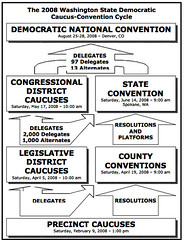
The image to the left, from the Washington Democratic Party, lays out the Democratic caucus-convention cycle with nice parsimony. It is, perhaps, a bit West-Washington centric. I understand that some areas in eastern Washington may select delegates to the state convention at the County Convention. Click on the image for a larger version.

The Republican cycle is organized differently, but the general idea for both parties is similar. A large number of delegates and alternates are elected at the neighborhood caucuses on February 9. Those delegates then attend subsequent caucuses where they vote amongst themselves to elect smaller numbers of delegates. By the end of the caucus-convention cycle a small number of Washington delegates, 97 Democrats and 40 Republicans, attend their respective national conventions to join with other delegates from around the country to elect the parties' nominees.

The caucus v. primary democracy question
The caucuses have been criticized as events that exclude large numbers of voters, while the primaries have been extolled as inclusive. This is a view put forward by people I respect, including Greg Rodriguez, the former Chair of King County Democrats who wrote here on Washblog that the caucuses are a futile attempt at democracy, and by Steve Zemke of Majority Rules blog, who was the campaign organizer for Initiative 99, which brought us the primary system to begin with. With due respect, I believe that this a mischaracterization -- at least in terms of the Democratic caucuses.

I'll go with the view of Krist Novoselic of US Fair Vote (and formerly bassist for Nirvana), who was one of the Democratic committee members who voted for the caucus process this year. Novoselic wrote on Washblog back in May that the 2008 caucuses will be a real exercise in democratic participation. "These local events," Novoselic wrote, "will fill with citizens eager to nominate candidates for president. We're in an age of apathy and we should not assault this process of civic engagement."

I believe that any defense of the caucuses against the charge that they are elitist has to start with an acknowledgment that we are struggling to maintain democracy with an electoral system that is seriously messed up. The opportunity to run for President is effectively closed to anyone who presents a serious challenge to the corporate powers that control the media and pay for elections. It is effectively closed to anyone who doesn't run under the label of one of the two major parties. Our elections run on dirty money, dirty tricks, lies, smears, fear-mongering, voter disenfranchisement and voter suppression. The caucuses are part of this dysfunctional system and they have their own additional flaws (2). But they are one of the brightest spots in a faltering system. I believe they are among our most democratic institutions.

Access versus meaning
On the Democratic Party side, at least, caucuses have evolved into a series of events that begin with caucuses that are wide open to input from any registered voter who declares as a Democrat. As the cycle progresses, input and participation from all players is narrowed, increasing the relative influence of the party "machine". But our system requires the organization and power that only a party machine can deliver. Absent some profound electoral reform -- which we're not going to get between now and November, 2008, no candidate with reasonable positions on the environment, social justice, and democracy can get elected without that power behind him or her. The caucuses are a major point of entry for the input of regular citizens -- we the people, we the democracy.

Yes, the primaries are more physically accessible because they are conducted by absentee ballot. But there is a trade-off for this access. They are also much more influenced by big-money electoral politics. Washington State Democratic Party Chair Dwight Pelz has said that the caucus system encourages grassroots democracy and dialogue while the primary favors candidates who spend the most money on TV ads and teaches participants that politics is a solitary process. I agree. (3)

Washington's primary and caucuses are scheduled after Super Tuesday. So the presidential nominees may be known by the time we hold the first caucus on February 9. If that's the case, we'll see less citizen participation in the caucuses, and we're not likely to see the presidential candidates traveling to Washington to court us. Would this be cause to stay home on February 9? I believe not!

What if it's all over by February 9?
Why not stay home from the caucuses if the race seems run?

Well, first, it's important to remember that an apparent early result can change. That's a slim - but real - possibility, and I write about it more later on.

Even beyond these horse race considerations, the caucuses are the key event in the presidential election cycle that allows Washington citizens to organize themselves for more impact on both primaries and the November general election for President and for all other candidates. History shows that even small numbers of people who care about their community can have a decisive impact on the outcome of elections.

The caucuses are a key opportunity to organize for a successful general election and for the kind of long-term civic community relationships that are necessary to keep democracy alive. They allow like-minded neighbors to bypass the usual electoral noise of money, power, and prejudice to share political information face to face. These are not symbolic benefits. They are the kind of neighbor-to-neighbor dialogue that is essential for rebuilding the integrity of our electoral democracy. The 2004 Democratic caucus in my neighborhood was democratically beautiful.

What happens at the caucuses?
There is no need to be an expert or an experienced partisan activist to take part in the caucuses. Most participants are not. The training provided by the Democratic Party requires that each person who walks into the building will be welcomed and helped to sign in and find a seat in a section assigned to his or her precinct, and participate meaningfully in the proceedings.

The primary order of business is to elect delegates from the precincts who will go on to the next level, the legislative district caucuses, to elect a smaller number of delegates from among themselves. A larger percentage of people who attend the precinct caucuses on February 9 will have an opportunity to serve as one of these delegates. Delegates can choose to be pledged to a candidate, or can choose to remain unpledged or undecided. The delegate elections take place after everyone is given a chance to speak on behalf of a candidate for a short amount of time (perhaps 2 minutes). At my neighborhood caucus in 2004 I was amazed at how many people got up to speak intelligently, sharing information that was new to me. The process was orderly and very respectful.

Resolutions are also introduced at the precinct caucuses. Any person attending can introduce these resolutions. By way of example, here are two sample resolutions posted by Democracy for Vancouver for impeaching George Bush and Dick Cheney that people can introduce on February 9th.

What if I want to participate and I can't attend the caucus?
Democrats who cannot attend the caucus because of physical disability, religious observance, or military service can file a surrogate form which allows them to both to stand for election as delegates and to vote for other delegates (by nominee preference). Republicans who are unable to attend for similar reasons can stand for election as a delegate but can't vote for other delegates. They also must contact the party to arrange for this in advance. (4) The Democrats have a delegate selection and affirmative action plan, which requires considerable outreach to the community and a robust effort to even out the playing field for gender and race. Here's the state Democratic Party page on the Caucus-Convention Cycle. Here's the state Republican Party Caucus and Convention Manual.

PRIMARY
The primary for both parties will be held on February 19. In some areas, there will also be a special election held for other offices at the same time. All registered voters can participate, as in any election. Here's the Washington Secretary of State 2008 Presidential Primary Page. The last day to register to vote for this election (with some exceptions) is January 19. Here's an online registration form, available starting January 7, 2008.

The Democratic and Republican nominees for President are elected by delegates who are appointed and elected through primaries and caucuses. They are not elected directly by the citizenry at large. So what's the primary for?

For Democrats, the answer to that question in 2008 is "not much". That's because the primary is scheduled after the caucuses, when it has the least affect on candidates' momentum -- and because the Democratic Party leadership decided early in the year to not use the primary results in allocating delegates.

There was a suggestion made early in the year that the Washington's primary be moved to February 5, "Super Tuesday". That would have allowed for the momentum established in the primary to feed into the caucuses. It would have allowed for those who voted in the primary to be mailed invitations to the caucuses. (5) Dave Gibney, a Democratic State Committeeman advanced this in a Washblog article in April: Washington Needs to Hold a Presidential Primary. The current configuration leaves the Democratic primary election "orphaned", or isolated from the rest of the political cycle. However, there is still a chance that a strong result for a candidate could get some media attention and add to that candidate's momentum.

The story is a little different for Republicans voting in the February 19 primary - though not a lot.

Washington's Republican Party has 40 delegates, total, to apportion to all presidential primary candidates (out of 2,476 Republican delegates nationally). They've settled on a complex formula to decide how these delegates will be pledged to individual presidential candidates. (6) By using both primary and caucus results to apportion that small number of delegates -- and by electing a quarter of their delegates at the state convention --after the primary and caucuses are all over -- the Republicans are diluting the impact of both the primary and the caucuses. I think their system maximizes party choice over citizen choice so much that I don't see much citizen choice left over. The Democratic use of the caucus system alone allows for caucus votes to have more impact -- enhancing both the advantages and flaws of the caucus system.

It is unfortunate that we're holding a $9.7 million primary that has, practically speaking, very little effect. Many people may remember that, in 2004, the presidential primary was canceled in a special session of the legislature. So we didn't have a primary that year at all. I am hearing that the legislature didn't cancel the primary again because neither party wanted to take the political heat for taking the primary "choice" away from voters. I don't know if that's true. It seems plausible.

A delegate situation
The presidential nominees for the parties are chosen by delegates. So it's worth dwelling for a moment on our state's delegate situation. How many delegates do we get? What does this mean for people backing Democratic or Republican candidates?

Washington has more Democrats than Republicans in statewide and national office -- and we've voted for the Democratic candidate for President in recent elections. So Democrats get more voice in the matter of choosing a presidential nominee for their party than Republicans do. Nationally, 4,367 Democratic delegates will vote for their presidential nominee. Ninety-seven Washington State Democratic delegates, about 2.2% of that total, will take part in that process. On the other side of the aisle, we have 2,476 Republican delegates voting for their party's nominee. Forty Washington State Republicans, about 1.6% of that total, will take part.

More on the delegate role
Washington's Democratic and Republican leadership decided back in March to keep the state's primaries and caucuses scheduled late in comparison with those of other states. The Democratic nominee needs 2,184 delegate votes (out of 4,367) to win. It will be possible for one nominee to have that many votes pledged to them by February 9. And even if there isn't an outright winner, it is likely that one or two strong front-runners will have emerged. I doubt that, by the time our state finalizes the caucus process on May 17, we won't have an apparent winner or a clear front-runner.

If it happens this way, it's still possible that something unexpected can change everything. A candidate can commit a major political blunder -- or their support can unexpectedly weaken. This happened with Howard Dean early in 2004. That could cause two candidates with close numbers to reverse their positions. Or even take the race in a completely unexpected direction. Delegates for several different candidates could pool their votes and put their collective weight behind a compromise choice. In these kinds of fluid circumstances, a single delegate advantage could make all the difference-- and all of this can influence the decisions of people in states who are voting even later in the game.

Staying home because the election seems like a done deal means giving up the chance to help add to the political weight behind a candidate you support -- and his or her platform. Numbers matter. Some attribute Howard Dean's Chairmanship of the DNC, for example, to his strong delegate presence in 2004. If Edwards or Kucinich delegates have a strong contingent at the National Convention -- or even make it possible through vote trading for one candidate to pull ahead of another -- are we are more likely to have a Department of Peace -- or more action on poverty in 2009? Possibly.

The most important reason to participate is that civic participation is what makes democracy work. The antidote to a manipulated electorate and a cheated majority is civic participation. The "party machine" that is so reviled in the media is actually -- on both sides of the aisle -- a major opportunity for ordinary citizens to bring back democracy.


The precincts, the precinct caucuses, and the position of Precinct Committee Officer are mandated in Washington state law because they form a democratic foundation for the two parties that have immense political power. This structure is not perfect is the true grassroots. Its power is waiting to be claimed by the citizenry.

"A student looks at local liberal bloggers"

Postman on Politics (Bothell Times political blog):
My quarter teaching at the University of Washington has come to an end. Times editor Jim Simon and I taught an advanced political reporting class to a small group of journalism students. It was a great experience for me. I found it difficult at first, but ultimately beneficial, to have to explain out loud what I do and why I do it that way. Simon and I didn’t always agree and we didn’t hide our debates from the students. (I figure they should learn early how wrong editors can be.)

I also learned from the work the students did. They went out and talked to voters about the presidential election and undertook in-depth final reporting projects. Over the next week I will share some of that work with you. I’ve edited them a little for posting here.

Today you can read Will Mari’s story about local liberal bloggers. The piece includes some pretty interesting comments from Democratic political consultants. Mari went to Victor’s Coffee in Redmond recently to talk with 20-year-old Andrew Villeneuve who was eager to explain how he’s going change politics in the Northwest. Read it after the jump.
Villeneuve sits near the window, wearing a baggy grey sweater. A black moustache clings to his upper lip. Speaking with the zeal of a revival preacher, he’s a true believer in the power of the “netroots.” It’s clear that he simply enjoys talking, mostly about his blog. His waves his hands excitedly, punching the air to punctuate his many points.

“It started out as a little idea,” he says, with obvious pride, “and it got bigger and bigger and bigger.”

The “it” is the impressively named Northwest Progressive Institute. It’s essentially a liberal blog and online “think tank” for young Democrats, or progressives, as Villeneuve prefers to call them. Launched in August 2003, when he was 17 years old, the “institute” consists of a blog, an interactive page of links to other, like-minded blogs, and a resource page for activists.

Villeneuve, a student at Bellevue Community College, says he wants to create a practical think tank that focuses on how to turn liberal policy ideas into reality in Olympia.
Villeneuve represents a new breed of left-leaning political bloggers in the Northwest. Newly energized, confident and eager to influence the vote, the bloggers who inhabit the local blogosphere are opening bigger stands in the marketplace of ideas, hawking their wares to whoever will stop and listen.

But exactly how much influence they exert is still up for debate.

Although the local “blogosphere” (a term first coined in 1999 by William Quick) has been active since the late 1990s, its presence wasn’t really felt until the war in Iraq and the 2004 presidential elections turned the casual readers of political news on both sides of the spectrum into avid writers. This was especially true in Seattle, where the majority of bloggers lean to the left.

Although liberal bloggers’ enthusiastic support for former Vermont Gov. Howard Dean did not propel him to the White House in 2004, they are quick to claim credit for the Democratic gains in the Congress during the 2006 midterm elections.

They are also quick to dismiss questions about their independence from the Democratic Party.

Villeneuve says his blog and others like it are designed to make their adopted party better, and claim they are not beholden to it. Others insist they are fiercely independent.

Veteran political consultants say this independence can either help or harm their candidates, because bloggers circumvent their usual means of getting media messages out.

“I’m frustrated as hell with the rise of the blogosphere,” says Christian Sinderman, a local Democratic consultant. “Blogs, for me, are this weird nether region … it’s usually stuff that’s not quite good enough to ended up printed somewhere, but it’s not quite nothing enough to end up going into the ether.”

They can be used as a dangerous political weapon, especially when they publish a rumor that can distort reality.

“There’s no editing, there’s no journalistic structure, but then it sort of gets a life of its own, and then it sort of takes off and makes it into a print version,” he says.

But political veterans like Sinderman aren’t shy about using blogs to their candidates’ advantage. The blogosphere can become a powerful fundraising and message machine in its own right.

This was illustrated in local liberal bloggers’ reaction to an Aug. 27 fundraising visit to Bellevue by President George Bush on behalf of U.S. Rep. Dave Reichert, R-Auburn. According reports filed with the Federal Election Commission, liberal bloggers responded by raising some $123,000 over that weekend for Reichert’s opponent, Darcy Burner.

The last-minute fundraising effort in August for Burner was titled “Burn Bush for Burner” and drew about 3,200 individual donors from around the country, said Burner’s campaign consultant manager, Sandeep Kaushik. It was coordinated and organized by some of the nation’s most popular liberal blogs, including DailyKos.com and firedoglake.com.

“They tend to be partisans, no question about that,” says Kaushik, a former writer for Seattle’s alternative weekly newspaper, The Stranger. “At the same time, they’re not part of the party structure.”

Their role in the public discourse is still largely undefined. “They kind of play this weird role that has this superficial semblance to journalism,” Kaushik says.

But for all their potential, it’s easy to get carried away by bloggers’ self-perpetuating hype. “There are a lot of overblown statements about the ‘power of the blogosphere,” he says.

While they may not be tools of the party, they want to help elect certain kinds of Democrats, namely, “progressive populists” that care about issues that matter to them, such as ending the war in Iraq, providing universal healthcare and promoting environmental initiatives that include bans on clear-cut logging and stronger restrictions on development.

As a pressure group on the Democratic Party, Kaushik says bloggers push their own agenda, and that doesn’t always agree with the party leadership, combining elements of a political movement with the behavior of a traditional constituency group.

“They’re not at the point yet where they can really swing a race,” he says. His challenge is keeping Burner from becoming too closely associated with the local liberal blogosphere, which overwhelmingly supports her. “Part of my job is making sure people know the blogosphere is not the campaign,” he says.


But liberal bloggers in the Northwest aren’t content to simply chat in cyberspace about their dream candidates and how they’ll someday work to solve public policy problems.

They work to get them elected now.

“That’s where the public policy becomes electoral, because you can’t have public policy unless someone’s going to implement it,” Villeneuve says.

His blog has actively supported Gov. Christine Gregoire and Burner. Villeneuve says his focus is on Washington state and that the presidential race is better left in the hands of national groups like MoveOn.org.

At Drinking Liberally, an informal gathering of blogger-types and local political aficionados that “promotes democracy one pint at a time,” Michael Hood of the liberal BlatherWatch blog admires Villeneuve’s energy.

“I’m glad he’s on our side,” Hood says. Villeneuve is chatting in the corner with his hero, David Goldstein (“Goldy”) of the outspokenly liberal HorsesAss.org. The P-I’s Joel Connelly holds forth at a long table, surrounded by a ragtag bunch of bloggers.

Standing in the darkened bar of the Montlake Ale House -- where the pints really do flow liberally -- Hood and his full white beard, round spectacles and fleece vest over button-down shirt strikes a contrast to the boyish Villeneuve.

Hood is a freelance writer whose blog “monitors” local conservative talk radio. He says Villeneuve is an example of an effective blogger. But when it comes to the issue of the blogosphere’s independence from the influence of the “mainstream” media, he’s fairly circumspect.

“It’s hard to know who’s independent and who isn’t,” he says.

The tendency is for the new media to become like the old, a process that’s already underway with the rush by journalists to set up their own blogs and podcasts. Journalists and bloggers have developed a sort of adversarial, quasi-symbiotic relationship, “fraught with dangers of the journalistic kind,” Hood says.

“Some people are undoubtedly paid shills,” admits conservative blogger Patrick Bell, who writes for respectfullyrepublican.com. Partisan bloggers on both sides sometimes take talking points verbatim from campaign press releases, he says. “Of course, this is also a very common refrain of bloggers when they get in ‘spats’ or ‘dustups’ with ideological foes: ‘you’re just a paid functionary for XYZ,’” Bell says.

Bloggers will be actively “pitched” by media consultants or other people with an axe to grind against a candidate during the campaign season, he said, adding, “then there’s the dirty tricksters and ‘tipsters’ who anonymously submit content to bloggers.”

“Journalism always has had a problem with circular cannibalism, everybody feeding on each other with a product that comes out all in one pile,” Hood says. He also points to another hazard as a real danger facing the blogosphere:

“Without editorial oversight, the facts are secondary many times to partisan spin and shock value [and] hyperbole.”

Downing his pint, he continues.

“There’s not too many Republicans on this side of the mountains,” he says, admitting that it feels a little one-sided in Seattle. While Rush Limbaugh made politics entertaining and created the impetus for liberal blogs, he laments that the “political discourse is driven by what makes people pissed off enough to call a radio station.”

But that might be changing, argues Kaushik. The fact that there is a new level of political dialogue on the Internet is a positive, especially in an age of media consolidation, shrinking newspaper staffs and the resulting lack of political news coverage and analysis.

Bloggers of both political orientations are fairly sophisticated when it comes to the finer points of policy, and influence the thinking of members of local government and journalists.

“I think it’s had a positive effect in terms of jumpstarting some serious discussions about some issues,” Kaushik said.

Villeneuve says that liberal blogs provide the political left with an alternative media to compete with the dominance of talk radio. And he says the job of the mainstream media, what he prefers to call the traditional media, to play referee between the left and right.
“Their job is just to report the news,” he said. And if they don’t do that, Villeneuve says he and his blogging brethren will.

He leans forward and his voice takes on a serious edge.

“Once we have an idea, we’re able to go an audience and say ‘here’s our idea.’ We don’t want to have to go to other people who control the gate and say, ‘please put our idea out there.’ We want to be in control … That’s why we have a blog.”
Howie P.S.: My attention was directed to this by Dan Kirkdorffer's post, "Postman and Connelly Highlighted by The Fix."

"New Obama Ads: Listening and Interest"


The Caucus, with video (NY Times political blog):
Senator Barack Obama, attempting to show his unflagging energy and hitting back at his Democratic rivals, released two ads in Iowa on Friday that thump his opponents on lobbying and health care and remind viewers of the senator’s message of urgency.
The ads – called “Listening” and “Interest” – include footage from Mr. Obama’s pivotal speech at the Jefferson-Jackson dinner here in November and shots of his enthusiastic, mostly white supporters. His first political swipe in “Interest” is at independent groups that support Hillary Rodham Clinton and John Edwards.

“While Iowans struggle with health costs, outside groups are spending millions to stop change, including false attacks on Barack Obama’s health plan,” the ad says, and shows footage of news articles about special interest groups and labor unions that have paid for ads attacking Mr. Obama.

In “Listening,” he nudges Mrs. Clinton on health care and Mr. Edwards on his connections with those groups, from which Mr. Edwards has tried to distance himself.

“I am in this race to tell the corporate lobbyists that their days of setting the agenda in Washington are over,” Mr. Obama said.

“Listening” and “Interest” both wrap up with Mr. Obama’s message to voters that he is one of them, not a cornerstone of the Washington establishment.

“Your future is our future,” he says in “Listening,” reminding voters that remembers their struggles, just as he did today during a campaign stop, in an attempt to establish a disconnect between Mrs. Clinton and American middle-class families.

“I think that’s part of what happens when you’re in Washington for a very long time,” he said at an elementary school in Williamsburg, Iowa. “It becomes harder to relinquish power.”


John Edwards: Obama 'Living in Never-Never Land'? (with video)

ABC News with video (02:10):
Edwards Criticizes Rivals as the Campaign in Iowa Enters the Home Stretch--In a wide-ranging, free-wheeling interview with Democratic presidential hopeful John Edwards with ABC News Friday afternoon, the former North Carolina senator labeled "ridiculous" comments made by the Obama campaign that seemed to link former Pakistan Prime Minister Benazir Bhutto's assassination to Sen. Hillary Clinton's vote to authorize the use of force against Iraq, embraced Sen. Barack Obama's politics over Clinton's, and said an anti-Obama flier from a pro-Clinton union was "misleading" and "deceptive."
Edwards also detailed his conversation with Pakistan's President Pervez Musharraf from Thursday in which he told that country's leader he needs to allow "independent international inspectors into Pakistan to determine the facts of what happened around the former prime minister's assassination. That kind of transparent process is the only way there's going to be any credibility."

ABC News spoke to Edwards on his way to his "closing argument" speech in Dubuque in which the candidate argued that his aggressive populism is necessary for the country, a message that he summed up as: "We have to stop the corporate greed that's killing the middle class in America."

Edwards told a friendly crowd at the Colt Drum & Bugle Corps Center in downtown Dubuque that "if we elect another president appointed by the status quo -- from either party -- the middle-class will fall further behind and our children will pay the price. ... Real change is going to take a real fight. It always does."

Implicit in his speech were criticisms of Clinton and Obama, with whom Edwards is locked in a three-way fight, according to local polls. Edwards' crowds seem to be growing, and anecdotally other campaigns say they see an uptick in his support in their internal campaign-tracking polls.

"To get real change, we need a president who will stand up against the big corporations and powerful interests that control Washington. Nobody who takes their money and defends the broken system is going to bring change," Edwards said, in a shot at the former first lady.

"And unfortunately," Edwards continued in his speech, turning his sights to Obama, "nobody who thinks we can just sit down and talk them into compromise is going to bring change either."

Edwards acknowledged in the interview that he was projecting a sunnier demeanor in these closing weeks of the campaign than previously when it came to criticism of his rivals. But he insisted his language against "the entrenched interests" is just "as aggressive and passionate."

Friday morning at a forum for undecided voters in Independence, Iowa, Edwards repeated his implicit criticism of Obama, saying any candidate who thinks he or she can invite corporate America to the table and achieve real results for Americans "is living in never-never land."

So he believes Barack Obama lives in never-never land?

"If he believes that, yes," Edwards said. "It's a little hard for me to tell sometimes based on the way he talks about this. I've heard him say he would give stakeholders a seat at the table. I assume he's talking about oil companies, drug companies and insurance companies."

In response, the Obama campaign pointed to an interview Edwards gave to the liberal website MyDD.com in Feburary, where Edwards was asked if he'd bring into the healthcare debate "both corporations and labor and healthcare groups and doctors" and he responded "I think you try to bring everybody to the table. You want their participation, you want to make the system work for everybody."

Obama spokesman Bill Burton said, "Edwards is ramping up his attacks as the caucus draws near but his new rhetoric on 'not negotiating or compromising or working with the powerful interests' is a sharp u-turn from what was once a quite conciliatory view towards those same powerful interests."

Asked during the interview if he thought Obama or Clinton would be better at bringing about change were he not in the race, Edwards indicated his preference was Obama.

"One of them believes change is necessary and the system doesn't work, and the other defends the system," he said.

But Edwards had plenty critical to say about Obama as well, assailing comments made Friday by Obama's senior adviser David Axelrod that seemed to link Clinton's October 2002 vote to authorize the war in Iraq -- a vote Edwards cast as well -- with Bhutto's assassination. "She was a strong supporter of the war in Iraq, which I submit is one of the reasons we were diverted from Afghanistan, Pakistan and al Qaeda, who may still have been players in this event," Axelrod said.

"It's ridiculous," Edwards said. "It's a ridiculous stretch. I think in times of international crisis -- which this clearly is -- what America needs to be doing and serious presidential candidates need to be doing is providing an atmosphere of strength and calm. We need to be a calming influence and not stoking the fire and certainly not be talking about the politics of this."

Edwards also dismissed comments from another Democratic presidential hopeful, New Mexico Gov. Bill Richardson, who Friday called for Musharraf to step down from power. "Some of my Democratic opponents have misplaced faith in Musharraf," Richardson said. "Like the Bush administration, they cling to the misguided notion that Musharraf can be trusted as an ally to fight terrorism."

"I haven't misplaced faith in Musharraf," Edwards said. "Musharraf has lots of problems, as we all know. And we have to keep the pressure on him. But I also think that a serious presidential candidate in a moment of crisis like this needs to show calm & and not be thinking about the politics of this."

Edwards took issue with a flier printed by a union supporting Clinton, AFSCME, which criticizes Obama's health care plan in part by using an Edwards quote criticizing the plan for not covering 15 million Americans, calling it "deceptive."

"By criticizing Sen. Obama and using me as a vehicle for the criticisms -- without saying that they're supporting Sen. Clinton and not me -- I think it's misleading," Edwards said.

His campaign bus, the Mainstreet Express, was met in Dubuque by a hometown favorite, the first lady of the state of Iowa, Mari Culver, who has endorsed Edwards.

Does that mean Gov. Chet Culver is secretly supporting Edwards? He wouldn't say.

"I'm not gonna touch that," he said laughing, as he walked off.

"The Hillary Song" (video)


This video (03:50) is presented as pro-Hillary but I'm not sure it works that way. Mr. Smith describes it thusly:
The opening credits, if the Clinton campaign were a 1980s sitcom.

"Obama Tops Final Democratic Power Rankings, Edwards and Clinton Tie for Second"

Iowa Independent:
With less than a week to go before Iowans brave the cold weather to attend their precinct caucuses, the Democratic race is as difficult to predict as ever. Campaigns have blanketed the state with candidates and surrogates, and staff are working long hours in their final push for supporters and volunteers.

Today, Iowa Independent releases its final round of power rankings, designed to answer the question, "If the caucuses were held tonight, what would be the results?" The rankings are derived from impressions we received from activists, campaign officials, seasoned political observers, and rank-and-file caucus-goers, but at the most basic level, they are based on the gut feelings and instincts of our writers, who have watched the race unfold here from the beginning.

A lot can change in six days, and we expect that it will. But if the caucuses were held tonight, this is how we think they would turn out:
First Place

Barack Obama -- The Obama campaign's ability to build a crowd is its greatest asset. The Illinois senator consistently seems to draw larger crowds than his opponents in the same places, which speaks both to the strength of his campaign's organization and the enthusiasm his candidacy seems to generate. And his wave of small-town newspaper endorsements should enhance his second-choice support in rural parts of the state where he has been perceived as weak. If the caucuses were held tonight, Obama would pull off a narrow victory.

Second Place

(tie) Hillary Clinton -- The Clinton campaign's ambitious "Every County Counts" tour the week before Christmas was not without errors, but its lasting impact seems to be that it firmed up some of the campaign's softer support and drew new caucus-goers in to hear what Clinton had to say. That, in combination with the Des Moines Register's endorsement and the extraordinary efforts of independent groups like Emily's List and AFSCME, would put Clinton in second place if the caucuses were held tonight.

(tie) John Edwards -- Edwards's greatest asset is the foundation he began building over a year ago. He has lost some of the activists he recruited early on to other campaigns, but in recent weeks his constant campaigning has firmed up his base. His supporters are likely to caucus, and many of them are experienced activists who know what it takes to get out the vote. If the caucuses were held tonight, we think he would finish second.

Fourth Place

Joe Biden -- Recent news out of Pakistan plays right into Biden's central argument: that the United States needs a thoughtful, experienced hand to guide its foreign policy. Biden may also benefit from widespread second-choice support from caucus-goers who do not wish to caucus for one of the top three candidates if they are forced to realign with other groups on caucus night.

Fifth Place

Bill Richardson -- Richardson's foreign policy experience may be his greatest asset, but his stump speech performances are inconsistent and sometimes unconvincing. One gets the sense that some caucus-goers feel he is not ready for prime time.

Sixth Place

Chris Dodd -- Dodd has pockets of support across the state, but he may not reach the 15% threshold for viability in many precincts. He continues to campaign energetically, and almost everyone likes him, but his candidacy has not caught on.

Seventh Place

Dennis Kucinich -- At this point, it remains to be seen whether Kucinich will even show up in Des Moines to give a concession speech on caucus night. He has spent such little time here that most of his hold-out supporters from 2004 have found other candidates.

Eighth Place

Mike Gravel

"Obama mixes it up over Pakistan"

Ben Smith (Politico):
Pakistan may have burst onto the television screens of average Americans Thursday morning with the assassination of former Prime Minister Benazir Bhutto. But for Sen. Barack Obama of Illinois, the turbulent nation at the forefront of the Bush administration’s war on Islamic terrorism had long ago quietly displaced Iraq as the central example in his attempt to articulate a new, dramatically different foreign policy.
And while many campaigns took studiously apolitical public stances in the wake of Bhutto’s murder, Obama’s advisers were frank in arguing that the new crisis on the subcontinent vindicates their candidate. Obama aides took particular aim at Sen. Hillary Rodham Clinton of New York, arguing that her vote to authorize the war in Iraq indirectly led to the turmoil in Pakistan by sapping resources from the battle against Al Qaeda. The skirmish reflects a larger struggle between an establishment Democratic view of the world and Obama’s call for a generational shift.

“Those who made the judgment that we ought to divert our attention from Afghanistan to invade Iraq and allow Al Qaeda to reconstitute and strengthen are now having to assess the wisdom of that judgment as we may be seeing yet another manifestation of Al Qaeda’s potency,” said Susan Rice, a top Obama foreign policy adviser who was an assistant secretary of state in the Clinton administration, in an interview with Politico.

She said Pakistan illustrates a difference between Obama and Clinton’s approaches to foreign policy. Clinton, in Rice’s view, is willing to tolerate authoritarian regimes — in this case the government of Pakistani President Pervez Musharraf — who might be useful to short-term U.S. goals. Obama, on the other hand, seeks a diplomacy that sees values and human rights than traditional realpolitik.

“Sen. Clinton’s view has been closer to Bush’s, which is to see Musharraf as the linchpin but democracy as something that is desirable, but not necessarily essential to our security interests,” said Rice. “Whereas Obama feels that democracy and human rights in the context of Pakistan are essential to our security.”

Clinton's campaign foreign policy adviser, Lee Feinstein, denounced Rice’s comments in an emailed statement that disputed her characterization.

“Sen. Obama's continuing and deliberate efforts to politicize this tragedy by blaming Sen. Clinton for it are unbecoming someone seeking the office of the presidency,” Feinstein said. “Sen. Clinton has opposed the Bush administration’s coddling of President Musharraf and stood steadfastly with the people of Pakistan in their struggle for democracy and against terrorism,” he said.

Earlier in the day, a comment by Obama political adviser David Axelrod linking Clinton to Bhutto’s death had met with a milder denunciation, and Axelrod later said he hadn’t meant to suggest Clinton was “complicit” in Bhutto’s slaying.

Obama defended Axelrod in an interview on CNN Thursday night, saying his strategist only spoke in response to an inappropriate question about the assassination’s effect on politics. But he said that “if we are going to talk politics, then the question has to be, ‘Who has exercised the kind of judgment that would be more likely to lead to better outcomes in the Middle East and better outcomes in Pakistan?'”

“To the extent there are those who are claiming now that their experience somehow makes them superior to deal with these issues — I think it's important for the American people to look at the judgments they've made in the past,” he said, referring to Clinton.

Thursday’s dispute came after a series of exchanges in debates and speeches this summer and fall in which Obama and Clinton — who had quibbled only over details of Iraq policy since she voted for the war, and he opposed it, in October 2002 — differed on U.S. policy in Pakistan.

Obama has argued for less concern about preserving the stability of the government of Musharraf and less compromise on establishing democracy. Clinton cast herself as a tough-minded veteran of the international scene, and Obama as a naïf.

Clinton has been a critic of Bush's staunch support for Musharraf. But she has also put herself firmly on Obama’s realist flank when it comes to Pakistan, in a running argument on terrain of Obama’s choosing.

On Aug. 1, he buried a surprise in the middle of a speech laying out his views on counterterrorism.

“If we have actionable intelligence about high-value terrorist targets and President Musharraf won't act, we will,” Obama said, openly suggesting cross-border raids into Pakistan which, while reportedly already a tool of American foreign policy through Special Forces actions, are a taboo subject. “Our goal is not simply an ally in Pakistan, it is a democratic ally,” he said.

Clinton, in a debate a week later, pointedly criticized his threat.

“It is a very big mistake to telegraph that and to destabilize the Musharraf regime, which is fighting for its life against the Islamic extremists who are in bed with Al Qaeda and Taliban. And remember, Pakistan has nuclear weapons. The last thing we want is to have Al Qaeda-like followers in charge of Pakistan and having access to nuclear weapons,” she said, chiding Obama. “You can think big, but remember, you shouldn’t always say everything you think if you’re running for president, because it has consequences across the world.”

Obama again appeared to side for democracy over stability after Musharraf declared a state of emergency in early November. Both he and Clinton denounced the move, but Obama went a step further, demanding that Congress set conditions on aid to Pakistan in a letter to the chairman of the Senate Appropriations Committee.

The next exchange on Pakistan came in a Nov. 15 debate in Las Vegas, where CNN’s Wolf Blitzer asked Obama whether “human rights [are] more important than American national security.”

“The concepts are not contradictory. ... They are complementary, and I think Pakistan is a great example,” Obama said. “We’ve got to understand that if we simply prop up anti-democratic practices, that that feeds the sense that America is only concerned about us and that our fates are not tied to these other folks.”

Clinton again seemed to take the moment to draw a contrast, in response to the same question, saying she agreed with Connecticut Sen. Chris Dodd, who had cautioned against conditioning aid to Pakistan on democratic reforms.

“The first obligation of the president of the United States is to protect and defend the United States of America,” Clinton said, appearing to advocate less-combative diplomacy. “Where we are today means that we have to say to President Musharraf, 'Look, this is not in your interest either. This is not in the interest of the United States. It is not in your interest to either stay in power or stay alive. We have to figure out how we're going to navigate this.'”

Obama was the first Democrat to release a statement after Bhutto’s assassination Thursday morning, just two hours and two minutes after she was pronounced dead in a hospital in Rawalpindi.

“I am shocked and saddened by the death of Benazir Bhutto in this terrorist atrocity,” he said, promising to stand with the Pakistani people “in their quest for democracy and against the terrorists who threaten the common security of the world.”

Rice said Obama isn’t likely to take any dramatic moves in the next few days that could further destabilize the country.

“This is a very sensitive and precarious situation, and it is not one on which we or anybody else ought to play politics and he won’t be doing that,” she said.
Howie P.S.: The Chicago Sun-Times has "Obama: U.S. needs to come down hard on Musharraf."

"A Biracial Candidate Walks His Own Fine Line" (with video)

NY Times: with video "The Obama Generation," (04:48).
The 2006 Democratic primary campaign for the presidency of the Cook County Board of Commissioners was vintage Chicago politics.

The incumbent was an aging party loyalist, mayoral confederate and institution in black Chicago. His opponent was younger and white, a reform-minded independent Democrat who had helped Barack Obama in his Senate race two years earlier.
Both sides wanted the support of Mr. Obama, a vote magnet in Chicago. The challenger, Forrest Claypool, 48, had the backing of the major newspapers and a couple of liberal members of Congress. The incumbent, John Stroger, 76, had the party organization, many of the city’s blacks and Mr. Obama’s political benefactor, the State Senate president, Emil Jones.

So Mr. Obama remained neutral. He was blasted in blogs and newspapers for hedging rather than risk alienating people he needed, though others said he had made the only shrewd choice.

“Those relationships are complex,” said Mr. Claypool, who lost the primary race to Mr. Stroger (who never served because of illness) and is now working on Mr. Obama’s presidential campaign. “No politician takes important relationships for granted.”

Much of Mr. Obama’s success as a politician has come from walking a fine line — as an independent Democrat and a progressive in a state dominated by the party organization and the political machine, and as a biracial American whose political ambitions require that he appeal to whites while still satisfying the hopes and expectations of blacks.

Like others of his generation, he is a member of a new class of black politicians. Too young to have experienced segregation, he has thrived in white institutions. His style is more conciliatory than confrontational, more technocrat than preacher. Compared with many older politicians, he tends to speak about race indirectly or implicitly, when he speaks about it at all.

After Hurricane Katrina, he did not attribute the lumbering federal response to the race of most of the storm’s victims. “The incompetence was color-blind,” he said, adding that the real stumbling block was indifference to the problems of the poor. After six black teenagers were charged with attempted murder in the beating of a white schoolmate in the “Jena Six” case in Louisiana, he said the criminal justice system needed fixing to ensure equal justice “regardless of race, wealth or circumstances.”

And when Mr. Obama announced his candidacy in February, he chose the steps of the Old State Capitol in Springfield, Ill., a place imbued with the spirit of Abraham Lincoln. He spoke of his work in “Chicago’s poorest neighborhoods” and of ending poverty; race came up only glancingly, as in, “Beneath all the differences of race and region, faith and station, we are one people.”

But the postracial style has its pitfalls.

‘Acting Like He’s White’

Earlier this fall, the Rev. Jesse Jackson, an Obama supporter who ran for president twice, was quoted by a reporter as saying Mr. Obama “needs to stop acting like he’s white” (words that Mr. Jackson has variously said that he would never say and that were taken out of context).

He added, “If I were a candidate, I’d be all over Jena.”

More recently, Mr. Jackson accused the Democratic candidates except for John Edwards of having “virtually ignored” the plight of blacks. (His son, Representative Jesse Jackson Jr., a national co-chairman of the Obama campaign, fired back in an op-ed column in The Chicago Sun-Times under the headline, “You’re wrong on Obama, Dad.”)

“A black candidate doesn’t want to look like he’s only a black candidate,” the Rev. Al Sharpton, the civil rights activist, who ran for president in 2004, said in an interview about Mr. Obama. “If he overidentifies with Sharpton, he looks like he’s only a black candidate. A white candidate reaches out to a Sharpton and looks like they have the ability to reach out. It looks like they’re presidential. That’s the dichotomy.”

In a telephone interview, Mr. Obama denied that he had spoken less about race issues than other candidates. But he said he focused when possible on “the universal issues that all Americans care about.” His aim, he said, is “to build broader coalitions that can actually deliver health care for all people or jobs that pay a living wage or all the issues that face not only black Americans but Americans generally.”

He suggested that his critics were comparing him not with Mr. Edwards or Senator Hillary Rodham Clinton but with Mr. Jackson and Mr. Sharpton. “That comparison is one that isn’t appropriate,” he said. “Because neither Reverend Jackson nor Reverend Sharpton is running for president of the United States. They are serving an important role as activists and catalysts but they’re not trying to build a coalition to actually govern.”

Mr. Obama’s legislative record does not diverge sharply from that of other black legislators, some who have studied it say. For example, the National Association for the Advancement of Colored People, which grades members of Congress on their support for its agenda, gave Mr. Obama a 100 percent score. The difference between him and some others lies more in life experience, approach to politics and style.

And while Mr. Obama’s advisers say he is entirely comfortable with his identity — as he has said, proud to be an African-American but not limited by that — he carries a peculiar burden as a presidential candidate: whether or not he calibrates his words, blacks as well as whites are likely to parse them for anything they might signal about racial issues.

“There is a special expectation and opportunity that we have to talk about the ways race works in America,” said Gov. Deval Patrick, a friend of Mr. Obama and the first black to lead Massachusetts.

But, Mr. Patrick said, “sometimes I think advocates want one note from us. I think our experience in our lives and in our politics has been that there’s much more than the one note — and sometimes a cacophony.”

There was a time when black politicians had little in common with white politicians. They had been educated in segregated schools and historically black colleges; many had entered politics through the civil rights movement, social activism or the black church. Their districts and constituents were overwhelmingly African-American. They were “race men” who had built their careers advocating for blacks.

Winning a Mixed District

They tended to be more liberal and militant than the Democratic Party as a whole, said Michael C. Dawson, a University of Chicago political scientist. They opposed rising military budgets and military intervention abroad, favored economic redistribution and were willing to consider such things as demands for reparation for slavery.

Hanes Walton Jr., a University of Michigan political scientist, said, “Once you got African-American elected officials in the 1960s and 1970s, there was huge demand from the black community about getting things done. Some of these elected officials came on with fairly rough edges because they were making consistent and hard demands. In many ways, that couldn’t be escaped. These elected officials knew that they were elected from the black community.”

Mr. Obama, by contrast, grew up in Hawaii and Indonesia, far from any center of black life. He graduated from a private prep school in Honolulu, Columbia College and Harvard Law School. Though he has belonged to the Trinity United Church of Christ in Chicago since 1987, he was not raised in the traditions of the black church, which Ange-Marie Hancock, a Yale political scientist, says “nurtured generations of black politicians” and “that almost exclusive emphasis on race — and race in a black/white framework.”

Mr. Obama was elected to the Illinois Senate in 1996 — not from an overwhelmingly black district like those that elected early black legislators but from a racially and economically mixed neighborhood, Hyde Park, home of the University of Chicago. In a state where Irish-American dynasties dominate Democratic Party politics, he sprang up as an outsider — a former community organizer without party or machine support.

Mr. Obama never fit any easily recognizable model of a black politician during his seven years in Springfield. He was a progressive Democrat who worked with Republicans; a black man whose weekly poker-game partners were white; an independent Democrat whose mentor, Mr. Jones, was one of the most powerful black politicians in the state and supported by the Chicago machine.

In his 2006 book, “The Audacity of Hope,” Mr. Obama recalls sitting with a white, liberal Democrat in the Senate and listening to a black, inner-city legislator, whom he identified only as John Doe, speechifying on how the elimination of a particular program was blatant racism. The white colleague turned to Mr. Obama and said, “You know what the problem is with John? Whenever I hear him, he makes me feel more white.”

Mr. Obama finds a lesson in that moment: White guilt has exhausted itself. Even fair-minded whites resist suggestions of racial victimization. Proposals that benefit minorities alone cannot be a basis for the broad coalitions needed to transform the country, he concluded. Only “universal appeals” for approaches that help all Americans, he wrote in his book, “schools that teach, jobs that pay, health care for everyone who needs it” can do that, “even if such strategies disproportionately help all Americans.”

Mr. Obama has never had difficulty appealing to whites. In his ill-fated 1999 campaign against Representative Bobby L. Rush, a four-term Democratic congressman and former Black Panther, Mr. Obama won the white vote but lost the black vote in a district that was overwhelmingly black. Abner J. Mikva, a former Illinois congressman and longtime supporter, said, “It took him a while to realize that it’s a vote that has to be courted.”

Hermene Hartman, the publisher of N’Digo, a weekly newspaper in Chicago, recalls advising Mr. Obama to talk less about his experience as the first African-American editor of the Harvard Law Review. “What I was saying early on was, ‘Harvard Review will play at the University of Chicago, it won’t play on 55th and King Drive,’” Ms. Hartman said.

Mr. Mikva says Mr. Obama learned to campaign in different ways without changing the substance of what he was saying. He learned to use rhythms, analogies, “quotes that resonate better.” Others say he simply worked hard at becoming better known, consolidating his support among black elected officials, black ministers, labor organizations and community groups, skating nimbly among factions.

Straddling Interests

Mr. Obama’s relationship with Mr. Jackson extends back at least to the early 1990s. Mr. Jackson’s daughter, Santita, was a friend of Mr. Obama’s wife, Michelle, and was a bridesmaid at their wedding. The Congressional district of Representative Jackson included Mr. Obama’s State Senate district; they have worked together on issues, endorsed some of the same reform-minded candidates against the party slate and sought each other’s advice.

At the same time, Mr. Obama has remained close to his longtime mentor, Mr. Jones — an old antagonist of Representative Jackson, who defeated him for Congress in 1995. Alan Gitelson, a political scientist at Loyola University in Chicago, said, “The skill of Obama is that he’s been able to straddle the two major factions among blacks in Illinois.”

Mr. Obama has also cultivated a working relationship with Mayor Richard M. Daley. Mr. Daley, who backed an opponent of Mr. Obama in the 2004 Senate primary, this year endorsed Mr. Obama for president — around the time that Mr. Obama endorsed Mr. Daley for re-election, annoying some supporters and passing over two black candidates considered unlikely to win.

“I can tell you, having worked for both of them, they are both pragmatists who want to get things done,” said David Axelrod, Mr. Obama’s chief strategist and a longtime consultant to Mr. Daley.

By the time Mr. Obama began running for the United States Senate, he “didn’t have to run as a black candidate,” said Don Rose, a longtime political consultant in Chicago. Illinois had already elected one black senator, Carol Moseley Braun, and Mr. Obama had nailed down overwhelming black support. According to Mr. Axelrod, he ended up with 92 percent of the black vote in a competitive field.

Yet race was a subtext of a television advertisement widely believed to have helped Mr. Obama win, Mr. Rose believes. The advertisement featured Sheila Simon, the daughter of former Senator Paul Simon, a Democrat who was a revered figure in Illinois politics, lionized by white progressives and admired by some conservatives. Mr. Simon, who had worked with Mr. Obama on ethics reform, had intended to endorse him but had died unexpectedly after heart surgery in 2003.

So Mr. Axelrod had asked Ms. Simon to make an advertisement about the similarities between her father and Mr. Obama. He said the commercial might help explain Mr. Obama’s unexpected success in white, working class neighborhoods on Chicago’s Northwest Side, which had been hostile to black candidates in the past. Mr. Rose believes that the advertisement’s subtext, intentionally or not, was gender and race: “It is saying, ‘People, I’m a white woman, and I’m not afraid of him.’”

Dining With Sharpton

In Washington, Mr. Obama made it clear almost immediately that his career would not be defined by his race. One of the first acts of the new Congress was to certify the results of the Electoral College. Some members of the Congressional Black Caucus moved to contest the certification of the Ohio votes. Mr. Obama did not join them. In a hastily arranged maiden speech, he said he was convinced that President Bush had won but he also urged Congress to address the need for voting reform.

In his office, he hung paintings of Lincoln, Gandhi and the Rev. Dr. Martin Luther King Jr., all of whom he calls his heroes.

In recent weeks, Mr. Obama has turned some of his attention to courting black voters. Nine months into his campaign, he held his first fund-raiser in Harlem, at the Apollo Theater, where he said, among other things, he was in the race because he was “tired of reading about Jena.” Then he went on tour with Oprah Winfrey, whom he had gotten to know when she interviewed him after his speech at the Democratic National Convention in 2004.

Mr. Sharpton, who has yet to endorse anyone, says Mr. Obama began his campaign as “the alternative to guys like me.” But in recent months, Mr. Sharpton said, “he’s been calling us.”

Mr. Obama also arranged to dine with Mr. Sharpton, in the presence of a herd of reporters, before his appearance at the Apollo.

“A portion of black voters want Obama to give them some raw meat,” said Julian Bond, chairman of the board of the N.A.A.C.P. “Because they want so badly to have their concerns addressed and highlighted, and they expect it of him because he’s black.”