Is Iraq Vietnam? Who really won in 2000? Which side are you on in the culture wars? These questions have divided the Baby Boomers and distorted our politics. One candidate could transcend them.--The logic behind the candidacy of Barack Obama is not, in the end, about Barack Obama. It has little to do with his policy proposals, which are very close to his Democratic rivals’ and which, with a few exceptions, exist firmly within the conventions of our politics. It has little to do with Obama’s considerable skills as a conciliator, legislator, or even thinker. It has even less to do with his ideological pedigree or legal background or rhetorical skills. Yes, as the many profiles prove, he has considerable intelligence and not a little guile. But so do others, not least his formidably polished and practiced opponent Senator Hillary Clinton.H/t to Bob Vermeers.Obama, moreover, is no saint. He has flaws and tics: Often tired, sometimes crabby, intermittently solipsistic, he’s a surprisingly uneven campaigner.
A soaring rhetorical flourish one day is undercut by a lackluster debate performance the next. He is certainly not without self-regard. He has more experience in public life than his opponents want to acknowledge, but he has not spent much time in Washington and has never run a business. His lean physique, close-cropped hair, and stick-out ears can give the impression of a slightly pushy undergraduate. You can see why many of his friends and admirers have urged him to wait his turn. He could be president in five or nine years’ time—why the rush?
But he knows, and privately acknowledges, that the fundamental point of his candidacy is that it is happening now. In politics, timing matters. And the most persuasive case for Obama has less to do with him than with the moment he is meeting. The moment has been a long time coming, and it is the result of a confluence of events, from one traumatizing war in Southeast Asia to another in the most fractious country in the Middle East. The legacy is a cultural climate that stultifies our politics and corrupts our discourse.
Obama’s candidacy in this sense is a potentially transformational one. Unlike any of the other candidates, he could take America—finally—past the debilitating, self-perpetuating family quarrel of the Baby Boom generation that has long engulfed all of us. So much has happened in America in the past seven years, let alone the past 40, that we can be forgiven for focusing on the present and the immediate future. But it is only when you take several large steps back into the long past that the full logic of an Obama presidency stares directly—and uncomfortably—at you.
At its best, the Obama candidacy is about ending a war—not so much the war in Iraq, which now has a momentum that will propel the occupation into the next decade—but the war within America that has prevailed since Vietnam and that shows dangerous signs of intensifying, a nonviolent civil war that has crippled America at the very time the world needs it most. It is a war about war—and about culture and about religion and about race. And in that war, Obama—and Obama alone—offers the possibility of a truce.
The traces of our long journey to this juncture can be found all around us. Its most obvious manifestation is political rhetoric. The high temperature—Bill O’Reilly’s nightly screeds against anti-Americans on one channel, Keith Olbermann’s “Worst Person in the World” on the other; MoveOn.org’s “General Betray Us” on the one side, Ann Coulter’s Treason on the other; Michael Moore’s accusation of treason at the core of the Iraq War, Sean Hannity’s assertion of treason in the opposition to it—is particularly striking when you examine the generally minor policy choices on the table. Something deeper and more powerful than the actual decisions we face is driving the tone of the debate.
Take the biggest foreign-policy question—the war in Iraq. The rhetoric ranges from John McCain’s “No Surrender” banner to the “End the War Now” absolutism of much of the Democratic base. Yet the substantive issue is almost comically removed from this hyperventilation. Every potential president, Republican or Democrat, would likely inherit more than 100,000 occupying troops in January 2009; every one would be attempting to redeploy them as prudently as possible and to build stronger alliances both in the region and in the world. Every major candidate, moreover, will pledge to use targeted military force against al-Qaeda if necessary; every one is committed to ensuring that Iran will not have a nuclear bomb; every one is committed to an open-ended deployment in Afghanistan and an unbending alliance with Israel. We are fighting over something, to be sure. But it is more a fight over how we define ourselves and over long-term goals than over what is practically to be done on the ground.
On domestic policy, the primary issue is health care. Again, the ferocious rhetoric belies the mundane reality. Between the boogeyman of “Big Government” and the alleged threat of the drug companies, the practical differences are more matters of nuance than ideology. Yes, there are policy disagreements, but in the wake of the Bush administration, they are underwhelming. Most Republicans support continuing the Medicare drug benefit for seniors, the largest expansion of the entitlement state since Lyndon Johnson, while Democrats are merely favoring more cost controls on drug and insurance companies. Between Mitt Romney’s Massachusetts plan—individual mandates, private-sector leadership—and Senator Clinton’s triangulated update of her 1994 debacle, the difference is more technical than fundamental. The country has moved ever so slightly leftward. But this again is less a function of ideological transformation than of the current system’s failure to provide affordable health care for the insured or any care at all for growing numbers of the working poor.
Even on issues that are seen as integral to the polarization, the practical stakes in this election are minor. A large consensus in America favors legal abortions during the first trimester and varying restrictions thereafter. Even in solidly red states, such as South Dakota, the support for total criminalization is weak. If Roe were to fall, the primary impact would be the end of a system more liberal than any in Europe in favor of one more in sync with the varied views that exist across this country. On marriage, the battles in the states are subsiding, as a bevy of blue states adopt either civil marriage or civil unions for gay couples, and the rest stand pat. Most states that want no recognition for same-sex couples have already made that decision, usually through state constitutional amendments that allow change only with extreme difficulty. And the one state where marriage equality exists, Massachusetts, has decided to maintain the reform indefinitely.
Given this quiet, evolving consensus on policy, how do we account for the bitter, brutal tone of American politics? The answer lies mainly with the biggest and most influential generation in America: the Baby Boomers. The divide is still—amazingly—between those who fought in Vietnam and those who didn’t, and between those who fought and dissented and those who fought but never dissented at all. By defining the contours of the Boomer generation, it lasted decades. And with time came a strange intensity.
The professionalization of the battle, and the emergence of an array of well-funded interest groups dedicated to continuing it, can be traced most proximately to the bitter confirmation fights over Robert Bork and Clarence Thomas, in 1987 and 1991 respectively. The presidency of Bill Clinton, who was elected with only 43 percent of the vote in 1992, crystallized the new reality. As soon as the Baby Boomers hit the commanding heights, the Vietnam power struggle rebooted. The facts mattered little in the face of such a divide. While Clinton was substantively a moderate conservative in policy, his countercultural origins led to the drama, ultimately, of religious warfare and even impeachment. Clinton clearly tried to bridge the Boomer split. But he was trapped on one side of it—and his personal foibles only reignited his generation’s agonies over sex and love and marriage. Even the failed impeachment didn’t bring the two sides to their senses, and the election of 2000 only made matters worse: Gore and Bush were almost designed to reflect the Boomers’ and the country’s divide, which deepened further.
The trauma of 9/11 has tended to obscure the memory of that unprecedentedly bitter election, and its nail- biting aftermath, which verged on a constitutional crisis. But its legacy is very much still with us, made far worse by President Bush’s approach to dealing with it. Despite losing the popular vote, Bush governed as if he had won Reagan’s 49 states. Instead of cementing a coalition of the center-right, Bush and Rove set out to ensure that the new evangelical base of the Republicans would turn out more reliably in 2004. Instead of seeing the post-’60s divide as a wound to be healed, they poured acid on it.
With 9/11, Bush had a reset moment—a chance to reunite the country in a way that would marginalize the extreme haters on both sides and forge a national consensus. He chose not to do so. It wasn’t entirely his fault. On the left, the truest believers were unprepared to give the president the benefit of any doubt in the wake of the 2000 election, and they even judged the 9/11 attacks to be a legitimate response to decades of U.S. foreign policy. Some could not support the war in Afghanistan, let alone the adventure in Iraq. As the Iraq War faltered, the polarization intensified. In 2004, the Vietnam argument returned with a new energy, with the Swift Boat attacks on John Kerry’s Vietnam War record and CBS’s misbegotten report on Bush’s record in the Texas Air National Guard. These were the stories that touched the collective nerve of the political classes—because they parsed once again along the fault lines of the Boomer divide that had come to define all of us.
The result was an even deeper schism. Kerry was arguably the worst candidate on earth to put to rest the post-1960s culture war—and his decision to embrace his Vietnam identity at the convention made things worse. Bush, for his part, was unable to do nuance. And so the campaign became a matter of symbolism—pitting those who took the terror threat “seriously” against those who didn’t. Supporters of the Iraq War became more invested in asserting the morality of their cause than in examining the effectiveness of their tactics. Opponents of the war found themselves dispirited. Some were left to hope privately for American failure; others lashed out, as distrust turned to paranoia. It was and is a toxic cycle, in which the interests of the United States are supplanted by domestic agendas born of pride and ruthlessness on the one hand and bitterness and alienation on the other.
This is the critical context for the election of 2008. It is an election that holds the potential not merely to intensify this cycle of division but to bequeath it to a new generation, one marked by a new war that need not be—that should not be—seen as another Vietnam. A Giuliani-Clinton matchup, favored by the media elite, is a classic intragenerational struggle—with two deeply divisive and ruthless personalities ready to go to the brink. Giuliani represents that Nixonian disgust with anyone asking questions about, let alone actively protesting, a war. Clinton will always be, in the minds of so many, the young woman who gave the commencement address at Wellesley, who sat in on the Nixon implosion and who once disdained baking cookies. For some, her husband will always be the draft dodger who smoked pot and wouldn’t admit it. And however hard she tries, there is nothing Hillary Clinton can do about it. She and Giuliani are conscripts in their generation’s war. To their respective sides, they are war heroes.
In normal times, such division is not fatal, and can even be healthy. It’s great copy for journalists. But we are not talking about routine rancor. And we are not talking about normal times. We are talking about a world in which Islamist terror, combined with increasingly available destructive technology, has already murdered thousands of Americans, and tens of thousands of Muslims, and could pose an existential danger to the West. The terrible failures of the Iraq occupation, the resurgence of al-Qaeda in Pakistan, the progress of Iran toward nuclear capability, and the collapse of America’s prestige and moral reputation, especially among those millions of Muslims too young to have known any American president but Bush, heighten the stakes dramatically.
Perhaps the underlying risk is best illustrated by our asking what the popular response would be to another 9/11–style attack. It is hard to imagine a reprise of the sudden unity and solidarity in the days after 9/11, or an outpouring of support from allies and neighbors. It is far easier to imagine an even more bitter fight over who was responsible (apart from the perpetrators) and a profound suspicion of a government forced to impose more restrictions on travel, communications, and civil liberties. The current president would be unable to command the trust, let alone the support, of half the country in such a time. He could even be blamed for provoking any attack that came.
Of the viable national candidates, only Obama and possibly McCain have the potential to bridge this widening partisan gulf. Polling reveals Obama to be the favored Democrat among Republicans. McCain’s bipartisan appeal has receded in recent years, especially with his enthusiastic embrace of the latest phase of the Iraq War. And his personal history can only reinforce the Vietnam divide. But Obama’s reach outside his own ranks remains striking. Why? It’s a good question: How has a black, urban liberal gained far stronger support among Republicans than the made-over moderate Clinton or the southern charmer Edwards? Perhaps because the Republicans and independents who are open to an Obama candidacy see his primary advantage in prosecuting the war on Islamist terrorism. It isn’t about his policies as such; it is about his person. They are prepared to set their own ideological preferences to one side in favor of what Obama offers America in a critical moment in our dealings with the rest of the world. The war today matters enormously. The war of the last generation? Not so much. If you are an American who yearns to finally get beyond the symbolic battles of the Boomer generation and face today’s actual problems, Obama may be your man.
What does he offer? First and foremost: his face. Think of it as the most effective potential re-branding of the United States since Reagan. Such a re-branding is not trivial—it’s central to an effective war strategy. The war on Islamist terror, after all, is two-pronged: a function of both hard power and soft power. We have seen the potential of hard power in removing the Taliban and Saddam Hussein. We have also seen its inherent weaknesses in Iraq, and its profound limitations in winning a long war against radical Islam. The next president has to create a sophisticated and supple blend of soft and hard power to isolate the enemy, to fight where necessary, but also to create an ideological template that works to the West’s advantage over the long haul. There is simply no other candidate with the potential of Obama to do this. Which is where his face comes in.
Consider this hypothetical. It’s November 2008. A young Pakistani Muslim is watching television and sees that this man—Barack Hussein Obama—is the new face of America. In one simple image, America’s soft power has been ratcheted up not a notch, but a logarithm. A brown-skinned man whose father was an African, who grew up in Indonesia and Hawaii, who attended a majority-Muslim school as a boy, is now the alleged enemy. If you wanted the crudest but most effective weapon against the demonization of America that fuels Islamist ideology, Obama’s face gets close. It proves them wrong about what America is in ways no words can.
The other obvious advantage that Obama has in facing the world and our enemies is his record on the Iraq War. He is the only major candidate to have clearly opposed it from the start. Whoever is in office in January 2009 will be tasked with redeploying forces in and out of Iraq, negotiating with neighboring states, engaging America’s estranged allies, tamping down regional violence. Obama’s interlocutors in Iraq and the Middle East would know that he never had suspicious motives toward Iraq, has no interest in occupying it indefinitely, and foresaw more clearly than most Americans the baleful consequences of long-term occupation.
This latter point is the most salient. The act of picking the next president will be in some ways a statement of America’s view of Iraq. Clinton is running as a centrist Democrat—voting for war, accepting the need for an occupation at least through her first term, while attempting to do triage as practically as possible. Obama is running as the clearer antiwar candidate. At the same time, Obama’s candidacy cannot fairly be cast as a McGovernite revival in tone or substance. He is not opposed to war as such. He is not opposed to the use of unilateral force, either—as demonstrated by his willingness to target al-Qaeda in Pakistan over the objections of the Pakistani government. He does not oppose the idea of democratization in the Muslim world as a general principle or the concept of nation building as such. He is not an isolationist, as his support for the campaign in Afghanistan proves. It is worth recalling the key passages of the speech Obama gave in Chicago on October 2, 2002, five months before the war:
I don’t oppose all wars. And I know that in this crowd today, there is no shortage of patriots, or of patriotism. What I am opposed to is a dumb war. What I am opposed to is a rash war … I know that even a successful war against Iraq will require a U.S. occupation of undetermined length, at undetermined cost, with undetermined consequences. I know that an invasion of Iraq without a clear rationale and without strong international support will only fan the flames of the Middle East, and encourage the worst, rather than best, impulses of the Arab world, and strengthen the recruitment arm of al-Qaeda. I am not opposed to all wars. I’m opposed to dumb wars.
The man who opposed the war for the right reasons is for that reason the potential president with the most flexibility in dealing with it. Clinton is hemmed in by her past and her generation. If she pulls out too quickly, she will fall prey to the usual browbeating from the right—the same theme that has played relentlessly since 1968. If she stays in too long, the antiwar base of her own party, already suspicious of her, will pounce. The Boomer legacy imprisons her—and so it may continue to imprison us. The debate about the war in the next four years needs to be about the practical and difficult choices ahead of us—not about the symbolism or whether it’s a second Vietnam.
A generational divide also separates Clinton and Obama with respect to domestic politics. Clinton grew up saturated in the conflict that still defines American politics. As a liberal, she has spent years in a defensive crouch against triumphant post-Reagan conservatism. The mau-mauing that greeted her health-care plan and the endless nightmares of her husband’s scandals drove her deeper into her political bunker. Her liberalism is warped by what you might call a Political Post-Traumatic Stress Syndrome. Reagan spooked people on the left, especially those, like Clinton, who were interested primarily in winning power. She has internalized what most Democrats of her generation have internalized: They suspect that the majority is not with them, and so some quotient of discretion, fear, or plain deception is required if they are to advance their objectives. And so the less-adept ones seem deceptive, and the more-practiced ones, like Clinton, exhibit the plastic-ness and inauthenticity that still plague her candidacy. She’s hiding her true feelings. We know it, she knows we know it, and there is no way out of it.
Obama, simply by virtue of when he was born, is free of this defensiveness. Strictly speaking, he is at the tail end of the Boomer generation. But he is not of it.
“Partly because my mother, you know, was smack-dab in the middle of the Baby Boom generation,” he told me. “She was only 18 when she had me. So when I think of Baby Boomers, I think of my mother’s generation. And you know, I was too young for the formative period of the ’60s—civil rights, sexual revolution, Vietnam War. Those all sort of passed me by.”
Obama’s mother was, in fact, born only five years earlier than Hillary Clinton. He did not politically come of age during the Vietnam era, and he is simply less afraid of the right wing than Clinton is, because he has emerged on the national stage during a period of conservative decadence and decline. And so, for example, he felt much freer than Clinton to say he was prepared to meet and hold talks with hostile world leaders in his first year in office. He has proposed sweeping middle-class tax cuts and opposed drastic reforms of Social Security, without being tarred as a fiscally reckless liberal. (Of course, such accusations are hard to make after the fiscal performance of today’s “conservatives.”) Even his more conservative positions—like his openness to bombing Pakistan, or his support for merit pay for public-school teachers—do not appear to emerge from a desire or need to credentialize himself with the right. He is among the first Democrats in a generation not to be afraid or ashamed of what they actually believe, which also gives them more freedom to move pragmatically to the right, if necessary. He does not smell, as Clinton does, of political fear.
There are few areas where this Democratic fear is more intense than religion. The crude exploitation of sectarian loyalty and religious zeal by Bush and Rove succeeded in deepening the culture war, to Republican advantage. Again, this played into the divide of the Boomer years—between God-fearing Americans and the peacenik atheist hippies of lore. The Democrats have responded by pretending to a public religiosity that still seems strained. Listening to Hillary Clinton detail her prayer life in public, as she did last spring to a packed house at George Washington University, was at once poignant and repellent. Poignant because her faith may well be genuine; repellent because its Methodist genuineness demands that she not profess it so tackily. But she did. The polls told her to.
Obama, in contrast, opened his soul up in public long before any focus group demanded it. His first book, Dreams From My Father, is a candid, haunting, and supple piece of writing. It was not concocted to solve a political problem (his second, hackneyed book, The Audacity of Hope, filled that niche). It was a genuine display of internal doubt and conflict and sadness. And it reveals Obama as someone whose “complex fate,” to use Ralph Ellison’s term, is to be both believer and doubter, in a world where such complexity is as beleaguered as it is necessary.
This struggle to embrace modernity without abandoning faith falls on one of the fault lines in the modern world. It is arguably the critical fault line, the tectonic rift that is advancing the bloody borders of Islam and the increasingly sectarian boundaries of American politics. As humankind abandons the secular totalitarianisms of the last century and grapples with breakneck technological and scientific discoveries, the appeal of absolutist faith is powerful in both developing and developed countries. It is the latest in a long line of rebukes to liberal modernity—but this rebuke has the deepest roots, the widest appeal, and the attraction that all total solutions to the human predicament proffer. From the doctrinal absolutism of Pope Benedict’s Vatican to the revival of fundamentalist Protestantism in the U.S. and Asia to the attraction for many Muslims of the most extreme and antimodern forms of Islam, the same phenomenon has spread to every culture and place.
You cannot confront the complex challenges of domestic or foreign policy today unless you understand this gulf and its seriousness. You cannot lead the United States without having a foot in both the religious and secular camps. This, surely, is where Bush has failed most profoundly. By aligning himself with the most extreme and basic of religious orientations, he has lost many moderate believers and alienated the secular and agnostic in the West. If you cannot bring the agnostics along in a campaign against religious terrorism, you have a problem.
Here again, Obama, by virtue of generation and accident, bridges this deepening divide. He was brought up in a nonreligious home and converted to Christianity as an adult. But—critically—he is not born-again. His faith—at once real and measured, hot and cool—lives at the center of the American religious experience. It is a modern, intellectual Christianity. “I didn’t have an epiphany,” he explained to me. “What I really did was to take a set of values and ideals that were first instilled in me from my mother, who was, as I have called her in my book, the last of the secular humanists—you know, belief in kindness and empathy and discipline, responsibility—those kinds of values. And I found in the Church a vessel or a repository for those values and a way to connect those values to a larger community and a belief in God and a belief in redemption and mercy and justice … I guess the point is, it continues to be both a spiritual, but also intellectual, journey for me, this issue of faith.”
The best speech Obama has ever given was not his famous 2004 convention address, but a June 2007 speech in Connecticut. In it, he described his religious conversion:
One Sunday, I put on one of the few clean jackets I had, and went over to Trinity United Church of Christ on 95th Street on the South Side of Chicago. And I heard Reverend Jeremiah A. Wright deliver a sermon called “The Audacity of Hope.” And during the course of that sermon, he introduced me to someone named Jesus Christ. I learned that my sins could be redeemed. I learned that those things I was too weak to accomplish myself, he would accomplish with me if I placed my trust in him. And in time, I came to see faith as more than just a comfort to the weary or a hedge against death, but rather as an active, palpable agent in the world and in my own life.
It was because of these newfound understandings that I was finally able to walk down the aisle of Trinity one day and affirm my Christian faith. It came about as a choice and not an epiphany. I didn’t fall out in church, as folks sometimes do. The questions I had didn’t magically disappear. The skeptical bent of my mind didn’t suddenly vanish. But kneeling beneath that cross on the South Side, I felt I heard God’s spirit beckoning me. I submitted myself to his will, and dedicated myself to discovering his truth and carrying out his works.
To be able to express this kind of religious conviction without disturbing or alienating the growing phalanx of secular voters, especially on the left, is quite an achievement. As he said in 2006, “Faith doesn’t mean that you don’t have doubts.” To deploy the rhetoric of Evangelicalism while eschewing its occasional anti-intellectualism and hubristic certainty is as rare as it is exhilarating. It is both an intellectual achievement, because Obama has clearly attempted to wrestle a modern Christianity from the encumbrances and anachronisms of its past, and an American achievement, because it was forged in the only American institution where conservative theology and the Democratic Party still communicate: the black church.
And this, of course, is the other element that makes Obama a potentially transformative candidate: race. Here, Obama again finds himself in the center of a complex fate, unwilling to pick sides in a divide that reaches back centuries and appears at times unbridgeable. His appeal to whites is palpable. I have felt it myself. Earlier this fall, I attended an Obama speech in Washington on tax policy that underwhelmed on delivery; his address was wooden, stilted, even tedious. It was only after I left the hotel that it occurred to me that I’d just been bored on tax policy by a national black leader. That I should have been struck by this was born in my own racial stereotypes, of course. But it won me over.
Obama is deeply aware of how he comes across to whites. In a revealing passage in his first book, he recounts how, in adolescence, he defused his white mother’s fears that he was drifting into delinquency. She had marched into his room and demanded to know what was going on. He flashed her “a reassuring smile and patted her hand and told her not to worry.” This, he tells us, was “usually an effective tactic,” because people
were satisfied as long as you were courteous and smiled and made no sudden moves. They were more than satisfied; they were relieved—such a pleasant surprise to find a well-mannered young black man who didn’t seem angry all the time.
And so you have Obama’s campaign for white America: courteous and smiling and with no sudden moves. This may, of course, be one reason for his still-lukewarm support among many African Americans, a large number of whom back a white woman for the presidency. It may also be because African Americans (more than many whites) simply don’t believe that a black man can win the presidency, and so are leery of wasting their vote. And the persistence of race as a divisive, even explosive factor in American life was unmissable the week of Obama’s tax speech. While he was detailing middle-class tax breaks, thousands of activists were preparing to march in Jena, Louisiana, after a series of crude racial incidents had blown up into a polarizing conflict.
Jesse Jackson voiced puzzlement that Obama was not at the forefront of the march. “If I were a candidate, I’d be all over Jena,” he remarked. The South Carolina newspaper The State reported that Jackson said Obama was “acting like he’s white.” Obama didn’t jump into the fray (no sudden moves), but instead issued measured statements on Jena, waiting till a late-September address at Howard University to find his voice. It was simultaneously an endorsement of black identity politics and a distancing from it:
When I’m president, we will no longer accept the false choice between being tough on crime and vigilant in our pursuit of justice. Dr. King said: “It’s not either/or, it’s both/and.” We can have a crime policy that’s both tough and smart. If you’re convicted of a crime involving drugs, of course you should be punished. But let’s not make the punishment for crack cocaine that much more severe than the punishment for powder cocaine when the real difference between the two is the skin color of the people using them. Judges think that’s wrong. Republicans think that’s wrong, Democrats think that’s wrong, and yet it’s been approved by Republican and Democratic presidents because no one has been willing to brave the politics and make it right. That will end when I am president.
Obama’s racial journey makes this kind of both/and politics something more than a matter of political compromise. The paradox of his candidacy is that, as potentially the first African American president in a country founded on slavery, he has taken pains to downplay the racial catharsis his candidacy implies. He knows race is important, and yet he knows that it turns destructive if it becomes the only important thing. In this he again subverts a Boomer paradigm, of black victimology or black conservatism. He is neither Al Sharpton nor Clarence Thomas; neither Julian Bond nor Colin Powell. Nor is he a post-racial figure like Tiger Woods, insofar as he has spent his life trying to reconnect with a black identity his childhood never gave him. Equally, he cannot be a Jesse Jackson. His white mother brought him up to be someone else.
In Dreams From My Father, Obama tells the story of a man with an almost eerily nonracial childhood, who has to learn what racism is, what his own racial identity is, and even what being black in America is. And so Obama’s relationship to the black American experience is as much learned as intuitive. He broke up with a serious early girlfriend in part because she was white. He decided to abandon a post-racial career among the upper-middle classes of the East Coast in order to reengage with the black experience of Chicago’s South Side. It was an act of integration—personal as well as communal—that called him to the work of community organizing.
This restlessness with where he was, this attempt at personal integration, represents both an affirmation of identity politics and a commitment to carving a unique personal identity out of the race, geography, and class he inherited. It yields an identity born of displacement, not rootedness. And there are times, I confess, when Obama’s account of understanding his own racial experience seemed more like that of a gay teen discovering that he lives in two worlds simultaneously than that of a young African American confronting racism for the first time.
And there are also times when Obama’s experience feels more like an immigrant story than a black memoir. His autobiography navigates a new and strange world of an American racial legacy that never quite defined him at his core. He therefore speaks to a complicated and mixed identity—not a simple and alienated one. This may hurt him among some African Americans, who may fail to identify with this fellow with an odd name. Black conservatives, like Shelby Steele, fear he is too deferential to the black establishment. Black leftists worry that he is not beholden at all. But there is no reason why African Americans cannot see the logic of Americanism that Obama also represents, a legacy that is ultimately theirs as well. To be black and white, to have belonged to a nonreligious home and a Christian church, to have attended a majority-Muslim school in Indonesia and a black church in urban Chicago, to be more than one thing and sometimes not fully anything—this is an increasingly common experience for Americans, including many racial minorities. Obama expresses such a conflicted but resilient identity before he even utters a word. And this complexity, with its internal tensions, contradictions, and moods, may increasingly be the main thing all Americans have in common.
None of this, of course, means that Obama will be the president some are dreaming of. His record in high office is sparse; his performances on the campaign trail have been patchy; his chief rival for the nomination, Senator Clinton, has bested him often with her relentless pursuit of the middle ground, her dogged attention to her own failings, and her much-improved speaking skills. At times, she has even managed to appear more inherently likable than the skinny, crabby, and sometimes morose newcomer from Chicago. Clinton’s most surprising asset has been the sense of security she instills. Her husband—and the good feelings that nostalgics retain for his presidency—have buttressed her case. In dangerous times, popular majorities often seek the conservative option, broadly understood.
The paradox is that Hillary makes far more sense if you believe that times are actually pretty good. If you believe that America’s current crisis is not a deep one, if you think that pragmatism alone will be enough to navigate a world on the verge of even more religious warfare, if you believe that today’s ideological polarization is not dangerous, and that what appears dark today is an illusion fostered by the lingering trauma of the Bush presidency, then the argument for Obama is not that strong. Clinton will do. And a Clinton-Giuliani race could be as invigorating as it is utterly predictable.
But if you sense, as I do, that greater danger lies ahead, and that our divisions and recent history have combined to make the American polity and constitutional order increasingly vulnerable, then the calculus of risk changes. Sometimes, when the world is changing rapidly, the greater risk is caution. Close-up in this election campaign, Obama is unlikely. From a distance, he is necessary. At a time when America’s estrangement from the world risks tipping into dangerous imbalance, when a country at war with lethal enemies is also increasingly at war with itself, when humankind’s spiritual yearnings veer between an excess of certainty and an inability to believe anything at all, and when sectarian and racial divides seem as intractable as ever, a man who is a bridge between these worlds may be indispensable.
We may in fact have finally found that bridge to the 21st century that Bill Clinton told us about. Its name is Obama.
I started posting on HowieinSeattle in 11/04, following progressive American politics in the spirit of Howard Dean's effort to "Take Our Country Back." I decided to follow my heart and posted on seattleforbarackobama from 2/07 to 11/08.--"Howie Martin is the Abe Linkin' of progressive Seattle."--Michael Hood.
Saturday, February 02, 2008
"Goodbye to All That: Why Obama Matters"
Friday, February 01, 2008
In case you missed it: "Video: CNN Democratic Presidential Primary Debate in California, January 31, 2008"
Part 1
Part 2
Part 3
Part 4
Part 5
Part 6
Part 7
Part 8
Part 9
Part 10
"Prominent Edwards supporter switches to Obama"
OLYMPIA — The woman who chaired John Edwards' 2004 and 2008 presidential campaigns in Washington state announced today she is now backing Sen. Barack Obama, D-Ill.Howie P.S.: I must confess I usually refer to this newspaper as the "Bothell Times" to indicate my sense of its spiritual home (and the actual site of its printing presses). Obama is rubbing off on me. Another endorsement: "MOVEON ENDORSES OBAMA."Jenny Durkan, a Seattle attorney, said she was disappointed that Edwards fared so poorly in other states and had to bow out of the race earlier this week. But she said she feels strongly that Obama is a better choice than Sen. Hillary Rodham Clinton, D-N.Y.
"I truly believe the country needs a new direction and it needs it both on a political level and on a spiritual level," Durkan said. "We need someone who can appeal to our better angels ... and I think he's the person best equipped to do that."
Durkan said Obama has been more consistent than Clinton in opposing the Iraq war, a stance she said will be key in winning the general election. And, after nearly three decades of having a Bush or Clinton in the White House, Durkan said it's time for a change.
"We're not a country of dynasties," she said.
Durkan is a close political ally of Gov. Christine Gregoire, who plans to announce next week who she is endorsing.
With the Feb. 9 precinct caucuses approaching, the Obama and Clinton campaigns are both aggressively pursuing Edwards supporters and prominent Democratic leaders who remain uncommitted. During a campaign swing through Washington on Friday, Sen. John Kerry — the party's presidential nominee in 2004 — met privately in Seattle with some of those people to try to persuade them to back Obama.
One person in the meeting was Yvonne Ward, an attorney from Auburn who was a Kerry delegate to the 2004 national convention. But Ward, a strong Edwards supporter, said after the meeting that she remained undecided.
Ward said she and most of the other Edwards supporters she knows are "kind of at sea. We're all a little bit lost and trying to figure out what to do."
Meanwhile, the latest campaign finance reports show that Obama continues to outpace all other candidates — Democrat or Republican — in raising money.
Obama raised more than $700,000 from Washington donors during the final quarter of 2007 and now has taken in more than $1.7 million here. Clinton raised about $540,000 during that period, bringing her state total to nearly $993,000.
Former Massachusetts Gov. Mitt Romney is tops among the Republicans, raising more than $700,000 here through the end of the year.
KUOW: "Interview with John Kerry" (audio)

KUOW, with audio (05:19):
2004 Democratic presidential nominee John Kerry recently endorsed Barack Obama. He was at the University of Washington at 9:00 a.m. on Friday, February 1st, 2008 with Mayor Greg Nickels and Representative Adam Smith talking about Obama. KUOW's Ross Reynolds talked with him on the phone for a few minutes before his speech.
About Billary and their friends
"CLINTON SURROGATE COMPARES OBAMA AD TO NAZI MARCH [UPDATED]" (with an apology).
Hillary Clinton made a point of stressing respect for Obama at Thursday night's debate. It is a shame that she is actually running a campaign that repeatedly smears him and disrespects the voters' ability to see through the facade.From Joe Conason:
"Step Back, Mr. Clinton":
The most likely motive for Bill Clinton’s reckless political performance in recent weeks, ironically and sadly, is to redress the terrible humiliations he inflicted on his wife in years past. But unless he quickly regains control of himself, the most likely result will be to inflict irreparable damage on the presidential aspirations of Hillary Rodham Clinton.From The Caucus, NY Times political blog, "The Week That Keeps On Going":
Well, another passion of Senator Kennedy’s life — or at least another legislative mission — has been the No Child Left Behind Act which he championed alongside Republicans and President Bush.Howie P.S.: "Oops, they did it again."---It is sad and painful to watch the Clintons as they struggle though a tough campaign stretch.
And out comes the supposedly newly muzzled former president-spouse, after a host of controversial remarks in South Carolina, California and Nevada that many believe hurt his wife’s campaign, at an appearance as he criss-crosses the country these next several days on behalf of his wife:
From MSNBC’s First Read, Mr. Clinton today called that legislation a “train wreck,” and invoked Senator Kennedy’s name. Now, much criticism has been heaped on that education initiative for being under-financed, based on teaching-to-the-test and just a mess of regulations that aren’t all-inspiring for the children, for the next-generation.
Now, he concedes mistakes were made on both sides. But invoking Senator Kennedy specifically by name? Accident? Uh, probably not.
"Bigger Than Limbaugh"
Over at Ruralvotes.com, Al Giardano notes a significant radio moment most of us gringos missed yesterday.On the El PiolÃn radio show, the most popular radio show in the U.S. , Sen. Ted Kennedy, D-Mass., called in to host Eddie Sotelo with a big love note to Sen. Barack Obama, D-Illinois, which Sotelo translated for his Spanish-speaking listeners.
“Only two senators marched for immigrant rights on May 1, 2006," Kennedy said, "one in Washington and the other in Chicago. I marched in Washington and Barack Obama marched in Chicago. He was not afraid to stand up when others wouldn’t.”
Kos considers this a pretty big moment.
Interestingly, even though she was in LA, Clinton last night continued to sound more moderate on the subject of illegal immigration. "You know, I was in Atlanta last night, and an African-American man said to me, 'I used to have a lot of construction jobs, and now it just seems like the only people who get them anymore are people who are here without documentation.'" she recalled. "So, I know that what we have to do is to bring our country together to have a comprehensive immigration reform solution."
After the debate, on MSNBC, Air America's Rachel Madow lambasted Clinton for those remarks, while Pat Buchanan praised her.
"Clinton Obama Hollywood Debate Wrap Up"

Video, (01:05).
Howie P.S.: Neither of the above were referenced at the debate, but they do capture my personal response to what did occur as I watched the debate at a neighbor's house, munching on chips and homemade dips. Hey, what was in those dips?? If you have the appetite for a more substantial pundit-laden all-you-can eat buffet, check out this two course video with Keith Olbermann questioning Josh Marshall, John Amato and Arianna Huffington.


Thursday, January 31, 2008
"Obama raises $32 milion in a month, closes the gap on Hillary"
Barack Obama raised a stunning $32 million in January, his campaign announced today, as a new national poll showed him pulling within six points of Hillary Clinton.Mr Obama's campaign manager, David Plouffe, said that the Illinois senator also added 170,000 new donors, with the strongest money-raising period the day after he lost the New Hampshire primary to Mrs Clinton.
Referring to next Tuesday's 22-state contest, Mr Plouffe said: “Obviously these resources are critical...we’ve been able to advertise in just about every February 5 state in pretty high levels."
The Clinton campaign has not yet released its funding results for the month.
With the Democratic nomination expected to drag on after Super Tuesday, when voters in 22 states go to the polls next wek, Mr Plouffe said the Obama campaign will tomorrow start advertising in states that vote after February 5, including Louisiana, Maine and Virginia.
As recently as ten days ago, Mrs Clinton led Mr Obama by 20 points in Gallup's national survey, but the Illinois senator has dramatically cut the gap. His surge follows the endorsement on Monday of Senator Edward Kennedy, the late John F Kennedy's brother, and after a backlash among many senior Democrats over aggressive tactics used by Bill Clinton during the South Carolina primary.
National polls usually have little bearing on contests in individual, early voting states such as Iowa and New Hampshire. But the new survey is an important indicator of the political environment ahead of Super Tuesday.
After accusations that the Clintons used racial tactics in South Carolina to scare white voters away from Mr Obama, Mr Clinton appears to have been reigned in by his wife. In appearances on her behalf in the past 48 hours, he has barely mentioned Mr Obama, instead remaining positive and focusing on his wife's policies.
Mrs Clinton last night apologised for any offence her husband had caused in South Carolina, telling ABC News: “I think whatever he said which was certainly never intended to cause any kind of offence to anyone. If it did give offences then I take responsibility and I'm sorry about that.”
Asked if she could control her husband, she said: “Oh, of course.” In a separate interview she did not deny that she had asked the former president to tone down his campaign rhetoric, and insisted that this was very much her presidential campaign.
Mr Obama, in contrast, has stepped up his criticism of Mrs Clinton, who is now trying to take the moral high ground in their nomination battle at a time when both are desperate to woo supporters of John Edwards, who dropped out of the race yesterday.
In a speech in Denver yesterday, before a huge crowd of more than 10,000, Mr Obama said a Hillary Clinton presidency would be a step back to the past, turning her husband's campaign theme from his 1996 election - building a bridge to the 21st century - against her. “I know it is tempting, after another presidency by a man named George Bush, to simply turn back the clock, and to build a bridge back to the 20th century," Mr Obama said.
Turning to Mrs Clinton's accusation that she is ready to lead America on Day One, and that he is not, Mr Obama said: “It's not enough to say you'll be ready from Day One; you have to be right from Day One." It was a reference to his pre-invasion opposition to the Iraq war, and Mrs Clinton's vote authorising the war.
Mrs Clinton, who is now focusing her message on the economy, jobs and health care - the bread-and-butter issues of most concern to Mr Edwards's supporters - responded. “That certainly sounds audacious, but not hopeful,” she said, a play on the title of Mr Obama's book, The Audacity of Hope. She added: “It's not hopeful and it's not what we should be talking about in this campaign. I would certainly ... hope we could get back to talking about the issues, drawing the contrasts that are based in fact that have a connection to the American people.”
Mrs Clinton holds several advantages heading into Super Tuesday. She has significant leads in the biggest, delegate-rich states of New York, California, New Jersey and Missouri. Yet because of the way Democrats award delegates - through proportional representation - it is mathematically impossible for either candidate to emerge victorious after February 5.
Mr Obama is hoping to do well in his home state of Illinois and in smaller states such as Georgia, Alabama, Kansas, Colorado and North Dakota. He is also trying to limit his opponent's advantage in New York and California.
In his speech, he depicted Mrs Clinton as a calculating, poll-tested, divisive figure who will only inspire greater partisan divisions in America.
Mrs Clinton vowed to take the high road. “I'm going to continue to talk to people about what we need to do in our country to try to lift people up, to keep focused on the future, to be very specific about what I want to do as president, because I want to be held accountable,” she said.
With Mr Edwards out, the debate in Los Angeles tonight will be Mrs Clinton's and Mr Obama's first head-to-head encounter, and their last joint encounter before Super Tuesday. It also demonstrates that, for the first time, the Democratic Party will not be picking a white male as its presidential nominee.
"A Dozen Reasons Why This Edwards Supporter is Backing Obama"
I gave John Edwards more money than I've given to any candidate in my life, and I'm glad I did. He raised critical issues about America's economic divides, and got them on the Democratic agenda. He was the first major candidate to stake out strong comprehensive platforms on global warming and health care. He hammered away on the Iraq war, even using scarce campaign resources to run ads during recent key Senate votes. He'd have made a powerful nominee-and president.I've been going through my mourning for a while for his campaign not getting more traction, so his withdrawal announcement didn't shock me. But sad as I am about his departure, I feel good about being able to switch my support to Barack Obama, and will do all I can to help him win.
I've actually been giving small donations to both since Iowa, while hoping that the Edwards campaign would belatedly catch fire, and exploring ways the two campaigns could work together. With Edwards gone, I think Obama is the natural choice for his supporters, and that Edwards should step up and endorse him as his preferred nominee. All three major Democratic candidates have their flaws and strengths-they all have excellent global warming plans, for instance. But Edwards wasn't just being rhetorical when he said that both he and Obama represent voices for change, versus Clinton's embodiment of a Washington status quo joining money and power.
Here are a dozen reasons why I feel proud to have my energy, dollars and vote now go to Obama:
1. The Iraq war: Obviously, invading Iraq remains the most damaging single action of the Bush era. Obama spoke out against it at a public rally while Clinton was echoing Bush's talking points and voting for it. Obama's current advisors also consistently opposed the war, while Clinton's consistently supported it. It's appropriate that Clinton jumped to her feet to clap when Bush said in his recent State of the Union address that there was "no doubt" that "the surge is working."
2. Clinton's Iran vote: The Kyl-Lieberman bill gave the Bush administration so wide an opening for war that Jim Webb called it "Dick Cheney's fondest pipe dream." Hillary voted for it. Obama and Edwards opposed it.
3. The youth vote: If a Party attracts new voters for their first few elections, they tend to stick for the rest of their lives. Obama is doing this on a level unseen in decades. By tearing down the candidate who inspires them, Clinton will so embitter many young voters they'll stay home.
4. Hope matters: When people join movements to realize raised hopes, our nation has a chance of changing. When they damp their hopes, as Clinton suggests, it doesn't. Like Edwards, Obama has helped people feel they can participate in a powerful transformative narrative. That's something to embrace, not mock.
5. Follow the money: All the candidates have some problematic donors-it's the system--but Hillary's the only one with money from Rupert Murdoch. Edwards and Obama refused money from lobbyists. Clinton claimed they were just citizens speaking out, and held a massive fundraising dinner with homeland security lobbyists. Obama spearheaded a public financing bill in the Illinois legislature, while Clinton had to be shamed by a full-page Common Cause ad in the Des Moines Register to join Obama and Edwards in taking that stand.
6. John McCain: If McCain is indeed the Republican nominee, than as Frank Rich brilliantly points out, he's perfectly primed to run as the war hero with independence, maturity and integrity, against the reckless, corrupt and utterly polarizing Clintons. Never mind that McCain's integrity and independence is largely a media myth (think the Charles Keating scandal and his craven embrace of Bush in 2004), but Bill and Hillary heralding their two-for-one White House return will energize and unite an otherwise ambivalent and fractured Republican base.
7. Mark Penn: Clinton's chief strategist, Mark Penn, runs a PR firm that prepped the Blackwater CEO for his recent congressional testimony, is aggressively involved in anti-union efforts, and has represented villains from the Argentine military junta and Philip Morris to Union Carbide after the 1984 Bhopal disaster.
8. Sleazy campaigning: Hillary stayed on the ballot in Michigan after Edwards and Obama pulled their names, then audaciously said the delegates she won unopposed should count retroactively. She, Bill and their surrogates have conducted a politics of personal attack that begins to echo Karl Rove, from distorting Obama's position on Iraq and abortion choice, to dancing out surrogates to imply that the Republicans will tar him as a drug user.
9. NAFTA: Hillary can't have it both ways in stoking nostalgia for Bill. NAFTA damaged lives and communities and widened America's economic divides. Edwards spoke out powerfully against it. Clinton now claims the agreement needs to be modified, but her husband staked all his political capital in ramming it through, helping to hollow out America's economy and split the Democratic Party for the 1994 Gingrich sweep.
10. Widening the circle: Obviously Obama spurs massive enthusiasm in the young and in the African-American community. I'm also impressed at the range of people turning out to support his campaign. At a Seattle rally I attended, the volunteer state campaign chair had started as Perot activist. The founding coordinator in the state's second-largest county, a white female Iraq war vet, voted for Bush in 2000 and written in Colin Powell in 2004 before becoming outraged about Iraq "I've always leaned conservative," she said, "but Obama's announcement speech moved me to tears. The Audacity of Hope made me rethink my beliefs. He inspires me with his honesty and integrity." As well as inspiring plenty of progressive activists, Obama is engaging people who haven't come near progressive electoral politics in years.
11. The story we tell: Obama captures people with a narrative about where he wants to take America. His personal story is powerful, but he keeps the emphasis on the ordinary citizens who need to take action to make change. Clinton, in contrast, focuses largely on her personal story, her presumed strengths and travails. Except for the symbolism of having a woman president, it's a recipe that downplays the possibility of common action for change.
12. Citizen movements matter: Edwards not only ran for president, but worked to build a citizen movement capable of working for change whatever his candidacy's outcome. Obama has taken a similar approach, beginning when he first organized low-income Chicago communities and coordinated a still-legendary voter registration drive. His speeches consciously encourage his supporters to join together and constitute a force equivalent to the abolitionist, union, suffrage, and civil rights movements. Like Edwards, he's working to build a movement capable of pushing his policies through the political resistance he will face (and probably of pushing him too if he fails to lead with enough courage). In this context, Clinton's LBJ/Martin Luther King comparison, and her dismissal of the power of words to inspire people, is all too revealing. She really does believe change comes from knowing how to work the insider levers of power. Edwards and Obama know it takes more.
That's why this Edwards supporter is proud to do all I can to make Barack Obama the Democratic nominee and president.
"Town Hall Meeting with U.S. Sen. John Kerry"
Obama for America Presents
a Town Hall Meeting with U.S. Sen. John Kerry
Friday, February 1, 2008 at 9am
University of Washington Husky Union Building (HUB) Auditorium
With special guests Seattle Mayor Greg Nickels and U.S. Rep. Adam Smith
Please RSVP online at http://my.barackobama.com/page/event/detail/4vrg8
or please call 206-529-3859 or email Washington@barackobama.com
Come learn more about Barack Obama from Obama supporter and 2004 Democratic presidential nominee John Kerry. Sen. Kerry recently endorsed Barack Obama, citing his judgment, character, and unique ability to bring about transformational change in our country.
"Not Only Fired Up for CHANGE, but raised 32M in January, alone!!!"
cross-posted @ One Million StrongA friend sent me a link of the late, great Senator Pat Moynihan's widow endorsing, Obama.
I must admit, I was surprised. Just as I have been surprised with Caroline Kennedy's endorsement, and her actively stumping for Barack Obama.
But what got me about Elizabeth B. Moynihan's endorsment was this:I know he would have become excited, as I have, to see Barack Obama rekindle hope in our young as he encourages them to participate in the political process, and I know Pat would approve, applaud and encourage me to join Caroline Kennedy in supporting Barack Obama’s candidacy for the Democratic nomination for president of the United States.
- icebergslim's diary :: ::
There is sheer excitement for Barack Obama. Every state he goes to, thousands just appear, as we have seen this week from Kansas, Kansas City, Denver, Phoenix, Birmingham, Atlanta, this is real.
Another thing that caught me was this from Mrs. Moynihan:
Mrs. Moynihan said she was inspired by an Op-Ed piece by Caroline Kennedy, the daughter of President John F. Kennedy, published on Sunday in The New York Times, and was also dismayed by the hostility Bill and Hillary Clinton have shown recently to Mr. Obama’s candidacy.
That dismay and resentment of the Clintons are real. Many who I know socially, through work, family members not following the primary race but picked up on the Clinton hostility in South Carolina, openly stated they don't like it.
Why should anyone like it? After South Carolina, who want to repeat that story? But it just makes you think, do we want or need another Clinton Administration? All those negative things, brought us back to what we had to deal with and witness under Bill Clinton, and it was not pretty.
That is why hope and optimism is important. Why? It gets folks, fired up and ready to go, for a purpose. It brings new voters out and those who are disenfranchised back in. It makes Independents swing our way, with some Republicans following, too. Why would anyone not want this for the Democratic Party? We all know that Barack Obama is bringing this steam and folks are responding.
What The Clintons tried to do in South Carolina was snuff out the possibility of hope and optimisim, for their own gain. But what they found out was that it is was rebuked, soundly and that Democratic establishment started to line up behind Barack Obama. Senator Ted Kennedy and Caroline Kennedy stuck a knife in The Clintons, by backing Barack Obama. Now they have to sit, watch and take it.
There is nothing wrong with fair game on one's record. It is total fair game. But the tactics of the Clintons sunk so low, they now are wondering if the voters will quietly, forcefully and soundly send a message. That is a vote for Obama.
Lastly, want to know how fired up Obama has been to the public? He raised 32M in January alone and plans to advertise, in states after February 5th. This is real.
Campaign manager David Plouffe said the campaign attracted 170,000 new donors for a total of 650,000 donors overall.Obama is advertising in all but two of the Feb. 5 states and plans to begin advertising in states with upcoming contests, including Louisiana, Washington, Nebraska, Maine, Maryland, Virginia and Washington, D.C.
YES WE CAN!!!!
MATT CAMERON OF PEARL JAM AND THE TOTAL EXPERIENCE GOSPEL CHOIR
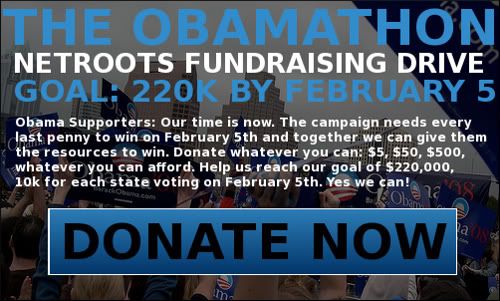
And to continue the roll to the White House, donate to the Obamathon:
Howie P.S.: Thanks to icebergslim for cross-posting the "Fired Up, Ready to Go" video here that was made in Seattle!
"Obama Amps It Up"
LOS ANGELES -- Somewhat overlooked Wednesday amid the hubbub over John Edwards' exit from the Democratic race was this: Barack Obama is slowly but surely ratcheting up his rhetoric against Hillary Clinton, building what amounts to a hard-edged closing case against his rival as the pair head into a high-stakes debate here tonight.Howie P.S.: CNN, 5-7pm PST.It has been a gradual buildup for Obama. After his defeat in Nevada, he started hitting Clinton in his stump speech for what he said were her misstatements on his record and platform, such as her charge that he was for a "trillion dollar tax increase on hard-working families" because he has said he is open to raising the $97,500 cap on salary taxed for Social Security. At his victory speech in South Carolina Saturday night, he broadened this out to a sweeping condemnation of Clinton's tactics as old politics. "Right now, that status quo is fighting back with everything it's got; with the same old tactics that divide and distract us from solving the problems people face," he said.
He has been carrying that theme forward all week, casting the opposition's criticisms as nothing but the defensive lashes of an establishment under siege. In his grandfather's hometown of El Dorado, Kansas on Tuesday, he echoed the South Carolina speech in declaring that the nomination battle was "about the past versus the future." "It's about whether we settle for the divisions and distractions and drama that passes for politics today, or whether we reach for a politics of common sense and innovation," he said.
But he took this a step further Wednesday in Denver, where he told a crowd of 9,000 in the University of Denver basketball arena (with thousands more listening in spillover areas elsewhere on campus) that Clinton -- without naming her name -- was not only the representative of old politics, but someone poorly positioned for the general election. It was the most explicit case against Clinton's electability he has made to date.
"We can be a Party that tries to beat the other side by practicing the same do-anything, say-anything, divisive politics that has stood in the way of progress; or we can be a Party that puts an end to it," he said. He continued: "We've reached Americans of all political stripes who are more interested in turning the page than turning up the heat on our opponents. That's how Democrats will win in November and build a majority in Congress. Not by nominating a candidate who will unite the other party against us, but by choosing one who can unite this country around a movement for change."
He made his attack on electability and effectiveness in office specific to trade, health care, and foreign policy. Voters, he said, "can't afford to wait another four years or another fifteen years to get health care because we've put forward a nominee who can't bring Democrats and Republicans together to get things done." On the war in Iraq: "It's time for new leadership that understands that the way to win a debate with John McCain...is not by nominating someone who agreed with him on voting for the war in Iraq; who agreed with him by voting to give George Bush the benefit of the doubt on Iran; who agrees with him in embracing the Bush-Cheney policy of not talking to leaders we don't like; and who actually differed with him by arguing for exceptions for torture before changing positions when the politics of the moment changed."
He concluded: "It's not enough to say you'll be ready from Day One - you have to be right from Day One."
And he kept it up in Phoenix Wednesday night, telling a crowd of more than 10,000 inside Arizona Veterans Memorial Coliseum that his campaign was attracting "all the usual reactions from Washington," as he mixed together the criticisms from Clinton with the anonymous emails calling him a radical Muslim and accusing him of not saluting the flag for the Pledge of Allegiance.
It all added up, he said, to a "smear campaign just like we've seen in the past, the rubbing raw of racial divisions, making us suspicious of one another, all the strategies designed to make us afraid. You know, we don't need fear. We're tired of the politics of fear...We're tired of the smear campaigns. We're tired of the racial divisions. That's all in the past. We want to go forward."
It's strong stuff, and the Clinton campaign did its best to knock it down, calling the Denver speech -- which for all its tough lines was delivered in Obama's customary lofty tones -- an "angry screed" that was "certainly audacious, but not very hopeful."
It should be a good debate tonight.
"Why Caroline Backed Obama"
Jonathan Alter (Newsweek)with video:Her kids, her uncle, her father—and Obama's father—all played a role.--For all the attention paid to Ted Kennedy's endorsement of Barack Obama, the more crucial seal of approval may be the one affixed by Caroline Kennedy. An Obama TV ad that features her is already being widely aired in Super Tuesday states. If Caroline helps Obama cut into Hillary Clinton's base among women over 40 (especially Roman Catholic women), Obama aides believe her involvement could prove important to the outcome.The behind-the-scenes story of Caroline's journey into the Obama camp features her three teenage children, her uncle—and a long-forgotten controversy from the 1960 presidential campaign. The complicated tale involves an angry Sen. John F. Kennedy, Vice President Richard Nixon's "truth squad," baseball great Jackie Robinson and a group of stranded African students trying to book passage to the United States—including Barack Obama Sr., father of the presidential candidate.
I've known Caroline since the 1970s, and with the help of a knowledgeable source have pieced together how she moved from neutral observer of the campaign to impassioned Obama supporter, shedding tears at American University on Monday as she witnessed a moment that, she believed, deeply fulfilled the ideals of her family.
"It was my father's spirit, living on in a meaningful, profound way," she said afterward.
For decades Caroline has dutifully campaigned for the Democratic nominee for president. But except for 1980, when her uncle Ted ran unsuccessfully for president, she has never involved herself in a party primary contest. She did not expect that 2008 would prove to be different, though her long relationship with the Clintons and her admiration of them left her open to possibly backing Hillary. During the Clinton administration she hosted a dinner party for the president and First Lady on Martha's Vineyard, went sailing with them and her family and stayed in irregular but friendly contact.
Like all Democrats, Caroline and her husband, Edwin Schlossberg, had admired Obama's keynote speech at the 2004 Democratic Convention. But she didn't consider his possible presidential campaign seriously until Christmas 2006, when a friend of her older daughter, Rose, a Harvard sophomore, sat in her kitchen and described how Ivy League students were already organizing for Obama even before he officially declared his candidacy.
Declining invitations to fund-raisers, she and her 17-year-old daughter Tatiana slipped unrecognized into a speech Obama made last April to an African-American audience in New York. Obama didn't realize she had been there until after he left, and he quickly called her to make amends for not saying hello, which was the first time they talked. She saw him speak again at an event on Martha's Vineyard over the summer (when she also saw a Hillary speech) and at a September Obama rally in Manhattan's Washington Square Park, where she stood unobtrusively at the rear of a huge crowd.
Unlike some voters, Caroline wasn't immediately swayed by his oratory. Instead she watched the campaign closely, read Obama's position papers and his memoir, "Dreams From My Father," and talked to Rose, Tatiana and Jack, now 15, whom Obama on Monday described as "my greatest advocates over the last several months." Like Missouri Sen. Claire McCaskill and Kansas Gov. Kathleen Sebelius, two other prominent supporters, Caroline credits her children with influencing her to take a closer look at Obama.
After Obama's big victory in Iowa, she spoke with the Illinois senator on the phone and pledged her support. Then, last week, Bill Clinton and his daughter Chelsea called her. Unlike Ted Kennedy's heated phone conversation with Clinton (which I learned of in mid-January from sources outside the Kennedy family), Caroline and the former president spoke cordially. But all along Caroline was talking much more frequently to Ted, with whom she is extremely close.
The Obama camp at first thought to send Caroline out to announce her support by campaigning with Obama on JFK Boulevard in New Jersey, but she decided instead to offer an op-ed piece to the New York Times, which she wrote on her own late one night, a few days before the Jan. 26 South Carolina primary. Before the article appeared she called Chelsea to tell her she was backing Obama.
One intriguing element of Obama's family history that resonated with Caroline was a long-buried story that was brought to her attention last summer. It drove home for her how history replays itself, how two generations of two families—separated by distance, culture and wealth—can intersect in strange and wonderful ways, and how people have no idea that their good deeds may come back to them someday.
Two weeks after he was nominated for president in July 1960, then-Senator Kennedy received a visit at his vacation home in Hyannis Port, Mass., from a Kenyan educator, Tom Mboya, who told him that more than 200 African students had received scholarships to American universities through the African-American Students Foundation but did not have the $100,000 for air transport. Despite efforts by Vice President Nixon (whom JFK would face in the November election), the Eisenhower State Department would not pay for what was described as "the African airlift."
With only weeks to go before the school year began, Kennedy quietly tapped his family's Kennedy Foundation, which agreed to raise the necessary funds privately. Upon learning this Nixon, seeking black votes, quickly convinced the State Department to reverse itself and offer the money, then arranged for one of his best-known African-American supporters, retired Brooklyn Dodgers star Jackie Robinson, to write a newspaper column praising him for coming to the aid of the African students.
But Nixon didn't stop there. Sen. Hugh Scott, who headed Nixon's campaign "truth squad," took to the Senate floor to denounce JFK for "plucking this project away from the U.S. government" in a "misuse of tax-exempt foundation money for blatant political purposes." Kennedy replied that this was "the most unfair, distorted and malignant attack I have heard in 14 years in politics."
When the truth finally emerged, Robinson wrote a column saying, "I don't mind admitting it—I was wrong." The airlift money came through from the Kennedy Foundation, and the students arrived. Barack Obama Sr. went to the University of Hawaii, where he met and married a young white woman from Kansas.
Their son, born the following year, arrived in the United States Senate in early 2005 and found that the antique desk he had been assigned on the Senate floor had once belonged to JFK, whose initials were carved inside. Obama learned only recently how his father's dream of studying in the United States had been fulfilled. A "young senator from Massachusetts" made an effort, Obama told the crowd at American University. "And because he did, I stand before you today."
The story captured why Caroline felt so satisfied by the symmetry of Monday's event. By Tuesday she was off to Colorado to begin campaigning with the man she believes is the true heir to her own father's legacy.
"He’s baaaacccckkk…Nader forms presidential exploratory committee"
Ralph Nader, the consumer advocate who has been accused by Democrats of helping hand the White House to George W. Bush in 2000, has formed a committee to explore another presidential bid.![]()
Sure to stir up a hornet’s nest, Nader launched an Internet site to recruit campaign workers, paid and unpaid, as well as to raise money for a possible White House run.
Donors who give $300 will receive three books and two DVDs, including Michael Moore’s Sicko movie about the state of health care in the United States.
He has run several times before, including in 2004 as an independent and in 2000 as the Green Party candidate. That year he was blamed by many for siphoning off votes from Al Gore and ultimately resulting in Bush securing the White House.
"Dori monson cohort is passed over in KIRO massacre"
Howie P.S.: One word always pops in my head when Monson's name is mentioned: "ass."
"This has got Dori's fingerprints all over it," says one KIRO-ite.
"It stinks," writes another. "He finally won."
The post-massacre KIRO weekend skedge is out and wonder of wonders: The Angel of Death passed over Phil, the news junkie's door! Besides the gardening Cisco and the cookin' Tom Douglas, the only local talk show left on the weekend is The News Junkie, the little show that does no harm, has neither listeners, nor point of view; but does have the tremendous advantage of being hosted by Phil Vandevort, the longtime producer for conservative DoriMonson, the self-proclaimed "King of Seattle Talk Radio."
David Goldstein, Bryan Styble, and Carl Jeffers and the support hours that go with them were eliminated Wednesday.
The Dori Monson Clause that retained Phil kinda blows a hole in the out-of-their-hands, "budgetary concerns" explanation they gave for laying off all these people.
It kinda blows...
"Dori has been after Goldy's hide for a year," says a newsie; "He's pushes his weight around, always has -- I don't know whether he got Goldy fired, but for sure if Phil's $300 a week job was saved, Dori was behind it."
Dori (whose name is a girl's name) stopped speaking or acknowledging Goldy's presence a few months ago.
KIRO staffers agree: Dori can be a real prick. "All this reminds me of the bad old Entercom days when you felt like you had to kiss his ass to keep your job."
This means a big loss of employment for the horrifically underpaid Board ops too. That's probably the reason Dustin Hornby walked. We'll be interested in hearing more about that.
It's only weekends, we know. But KIRO's closing them down for fledgling local talent is the end of an era. There is effectively no way for a talk host in this town to get started.
We'll probably pass on The Mutual Fund Show, and we can only listen to Bob Brinker once a week.
But take it from us: NPR is where it's at on weekends: in case you haven't already been driven away from KIRO. check out the weekend fare on KUOW.
Here's the Saturday line-up (except they don't say who will be in the former Carl Jeffers spot at 10p or on the overnight -- can't wait to find out!):
6am – 9am KIRO Morning News
9am- 10am The Mutual Fund Show
10am – 1pm In the Garden w/Cisco Morris
1pm to 4pm Bob Brinker Show
4pm-7pm In the Kitchen w/Tom Douglas
7pm-10pm Best of TBTLDoesn't get much more exciting on Sunday:
6am -9am KIRO Morning News
9am- 10am Meet the Press
10am- 1pm Handel on the Law
1pm- 4pm Bob Brinker Show
4pm-7pm The News Junkie
7pm-8pm CBS News Weekend Round-up
8pm-9pm Meet the Press (Repeat)
9pm-Midnite Leo LaPorte – The Tech Guy
Midnite to 4am Bob Brinker (Repeat)
"For John Edwards, A Moment of Truth"
Politics demands that some truths cannot be told. You cannot divulge how much you ache inside, how difficult defeat is to swallow until you swallow it.A week ago John Edwards was on his campaign bus barnstorming through rural South Carolina when he was asked a question that so many were pondering about his presidential candidacy: Are you in the Democratic race for the long haul?
"Yes, sir," he said.
Regardless of how well you do in the South Carolina primary or on Super Tuesday? Is there any calculation that would change your mind?
Edwards shook his head, no. He would compete all the way to the Democratic National Convention.
"This is not about me or my personal ambition," he said in the interview. "It's about the cause and the voices who are not being heard."
Yesterday, Edwards ended his campaign where he began it, in New Orleans, invoking the cause of poverty and the voices of janitors, nurses and poultry workers. He ended it with a straightforward declarative sentence: "It's time for me to step aside so that history can blaze its path." That was a simple truth he had long known, for either Barack Obama or Hillary Clinton was bound to win the Democratic nomination. But it was a truth he felt he could not reveal even a week ago.
Hindsight is a cheap piece of instant wisdom, not nearly so valuable as prescience. But here's some hindsight from South Carolina: As Edwards campaigned there, a native son come home, his voice was strong and passionate whenever he was onstage or bellowing from a bullhorn. But when he was mingling in a diner, when folks were whispering in his ear, when he was signing their posters, his eyes sometimes told a different story -- and not one of attentive exuberance. He had the dead eyes of a candidate looking past the moment.
At Whiteford's Giant Burger in Laurens, S.C., a retired woman beckoned him toward her. "I don't know if I can get way over there," Edwards told her. "I'm sorry." She was not more than 10 feet away. Would Edwards have made the small effort at a different point in his campaign? For whatever hindsight's worth.
And there was this: "The whole country knows [Elizabeth] is terminally ill," former Georgia congressman Ben Jones said of Edward's wife and political partner. "If it's you or me, it's a no-brainer. Elizabeth is such a trouper, and she campaigned so relentlessly, I'm sure she was exhausted. I think he made the right decision on a personal level, that his priority was her health. It's hard for either one of them to give this up."
Beginning Tuesday night and continuing yesterday morning, Edwards made phone calls to people who needed to know of his decision before he announced it. He reached Dave "Mudcat" Saunders, a senior strategist and the campaign's national rural liaison, in a hotel room in Atlanta. Saunders was preparing for Super Tuesday. The news turned him melancholy.
"I'm a Scots-Irish hillbilly. I operate on passion rather than intelligence," he said. Saunders spoke by phone yesterday evening while traveling the highways headed home to Virginia. "I'm going to get home and get under my bed and get in a fetal position and suck my thumb with my gun, and then get back out there."
When Edwards phoned, he told Saunders: "I just want you to know you're my pal." According to Saunders, Edwards was more worried about him than anything else. Edwards did not, however, speak another truth that seems evident: He is drawn more to Obama than to Clinton.
Campaign advisers say this, and Edwards's debate and stump performances say this. Yesterday, however, all Edwards would say is he will continue talking to both candidates but not endorse anyone just yet.
But here's what ol' Mudcat had to say about that: "I'm going to do everything I can to make sure it's not Hillary Clinton." Saunders added: "Hillary Clinton has about as much chance of beating John McCain as this Scots-Irish hillbilly has of becoming pope."
This, of course, presumes John McCain will be the Republican nominee. But regardless, Saunders's logic is that there is no state in the country that Clinton can win that John Kerry didn't win in 2004. Which leaves the Democrats a state short of victory.
"I've gone over the math carefully," said Saunders. "Barack Obama, I don't know enough about him to make that decision on whether he can win. I've never met him. But his chances would have to be stronger than Hillary's."
Hillary?
"She's got toxic coattails," added Saunders. "I think it could be devastating for the party."
John Edwards would never say anything like that.
When asked in the interview last week if he had more in common with Obama or Clinton, there was a nine-second pause. "It's a complicated question," Edwards finally said. And then he went into, for a second time, how much pride he felt that his party could have an African American and a woman as its two leading candidates. "I'll just leave it at that for now."
But others won't.
Jones, best known as Cooter on the 1980s TV show "The Dukes of Hazzard," campaigned for Edwards in all of the early states. He said most of the Edwards staffers he dealt with were partial to the senator from Illinois. Interviews with other campaign aides suggest Jones is onto something. One senior Edwards adviser said Obama was not perfect, but comes closest to being a consensus second choice: "Clinton is the status quo, Obama appeases the status quo. And John fights the status quo."
Except John has left the ring.
"I've already enlisted in the Barack Obama campaign," Jones said. "The fight goes on. It's about the past and the future, and I'm with the future. I think the Clintons are the past."
As for what Edwards will do?
That truth is known. It just hasn't been revealed.
"Clintons come calling: Time to repay favors"
Hillary and Bill Clinton are calling in 15 years' worth of political IOUs and asking old friends for help as they try to head off Illinois Sen. Barack Obama in Washington's Feb. 9 Democratic precinct caucuses.
"The loyalty goes back a long ways," Sen. Patty Murray, D-Wash., noted Wednesday as she endorsed Hillary Clinton.Murray put parameters on the endorsement, saying she was acting out of "personal loyalty and friendship." Murray, a member of the Senate Democratic leadership, will not participate in the caucuses.
She was pointed about which Clinton she is embracing.
"I told Hillary that finding her own voice was absolutely critical," she said. "My support is for Hillary and the Hillary I knew before she went to the Senate and with whom I have served in the Senate."
Asked about recent days, in which ex-President Clinton attacked Obama and overshadowed his candidate wife, Murray posed a question asked by many Democrats across the country: "Who controls him?"
Gov. Chris Gregoire said she will endorse a candidate next week before the caucuses. Two close colleagues, Govs. Janet Napolitano of Arizona and Kathleen Sebelius of Kansas, have come out for Obama.
Gregoire was not tipping her hand, but acknowledged that the Obama-Clinton choice is much tougher than she expected.
"I will admit to you that I have vacillated," the governor said. "Where I was two months ago is not where I am today. I love the message of hope that he sends. But I really admire her experience."
Asked who is lobbying her, Gregoire replied: "Oh boy! Bill Clinton is trying to connect with me. Obama is trying to get hold of me." She has heard Clinton pitches from ex-Iowa Gov. Tom Vilsack and former Maryland Lt. Gov. Kathleen Townsend.
Gregoire gave a succinct answer to why she is being courted. "I think this state is absolutely in play," she said.
Withdrawal by John Edwards on Wednesday reduced the Democratic field to a two-person choice, pitting the first African-American to mount a viable bid for the presidency against the first woman with a clear shot at the White House.
"With Edwards out, my choice is Obama," Seattle City Council President Richard Conlin said after a breakfast with Madrona neighbors.
The Democrats' 2004 presidential nominee, Sen. John Kerry, D-Mass., will campaign Friday in Seattle for Obama.
And Obama is coming back to the Northwest on Saturday. He will rally Democrats in Idaho, one of the nation's "reddest" states. Idaho holds its presidential caucuses on Super Tuesday.
Obama has been in the Seattle area four times. He drew big crowds to 2006 events at Garfield High School and Bellevue Community College, and packed Benaroya Hall for a lecture on his book "The Audacity of Hope."
The two visits of Obama's presidential campaign have combined inexpensive events -- a rally and a rock concert -- with pricey private fundraisers.
The Clintons have adopted a pay-per-view policy since the last big Pike Place Market rally of the 1996 presidential campaign. Bill Clinton has hawked books. He has collected $100,000-plus speaking fees in British Columbia. He has solicited local billionaires to help launch his foundation.
Hillary Clinton talked at a state Democrats awards ceremony in October, but squeezed no fewer than three private $2,300-a-person fundraisers into a 15-hour visit. She raised money for Sen. Maria Cantwell's 2006 re-election, but also took in $100,000 at a reception for her own Senate campaign.
The Clintons have done favors for which they can call in chits.
Cantwell, who endorsed Hillary Clinton early this month, has cited the Clintons' help in retiring her 2000 campaign debt. Bill Clinton raised $330,000 in a Seattle visit. Hillary Clinton opened her Embassy Row mansion in Washington, D.C., for a Cantwell fundraiser.
Hillary Clinton did a 1998 fundraiser for House candidate Jay Inslee at Dale Chihuly's glass sculpture studio. Bill Clinton wrote the foreword to Inslee's recent book "Apollo's Fire."
Inslee is a co-chairman of Hillary Clinton's presidential campaign in Washington.
Both Clintons campaigned here for Cantwell in 2006. Bill Clinton did a fundraiser to benefit Rep. Jim McDermott's legal defense fund. McDermott fought a decadelong legal battle with Rep. John Boehner, R-Ohio, over the leak of an illegally taped conversation between House Republican leaders.
Hillary Clinton has been soliciting McDermott's support in a battle for the hearts and minds of Seattle liberals.
She has twice been the keynote speaker at Murray's annual Golden Tennis Shoes awards ceremony and fundraising lunch.
Murray praised Clinton's "steeliness and courage" in the face of a hostile crowd turned out by right-wing radio hosts in 1994 when the first lady launched a "Health Care Caravan" in Seattle.
The health care rally was one of two jolts that Clinton has experienced in coming to Seattle. The other was a mild earthquake that shook Seattle shortly before one of Murray's luncheons.
A joke ran across the ballroom, namely that the phrase "The earth moved!" was usually associated with Bill Clinton.
ENDORSEMENTS
Prominent Washingtonians who have endorsed presidential candidates in the '08 race:
Hillary Clinton: Sens. Patty Murray and Maria Cantwell; King County Executive Ron Sims; Rep. Jay Inslee; former Gov. Gary Locke.
Barack Obama: Rep. Adam Smith; Seattle City Council President Richard Conlin; former Seattle Mayor Norm Rice.
John McCain: Attorney General Rob McKenna; former Gov. Dan Evans; former Sen. Slade Gorton.
"YOUTUBE TO YOUBAMA" (with video)
Barack Obama recently shattered YouTube records with popular speeches, and now his YouTube fans are talking back.Obama's videos keep breaking campaign records -- his rebuttal to the State of the Union drew over 700,000 views in two days -- and some people are uploading their own grassroots videos on his behalf. A new site, YouBama.com, invites people to join a "citizen generated campaign" to advance Obama's candidacy.But it does reflect a sizable public appetite for hearing directly from the candidates about substance -- rather than the punditry, strategy and polls that dominate campaign media coverage.
![]()
Founded this week by Eric Park and Christopher Pedregal, two computer science alums from Stanford, YouBama is a hub for people to put their Obama support into words. It features testimonials from random people, political activists, Internet celebrities like Craigslist founder Craig Newmark, and real celebrities like Charles Barkley. "There's nothing more convincing than finding someone who really believes in a candidate and can tell you why when its heartfelt," said Pedregal in an interview with The Nation. "It might resonate more than a pre-packaged ad," he added. Pedregal and Park made the site in their free time and they do not run any advertising on it.
Since its launch this week, with a plug from the hot blog TechCrunch, YouBama has drawn 22,000 visitors. That's solid for a new, unfunded site, though it won't catch Obama's YouTube channel anytime soon. That portal has drawn over 11 million views -- about ten times that of Hillary Clinton -- and it is the most viewed channel across YouTube this week. (Many of the viewers are new people who are not on Obama's email or social network lists, for example, over 25,000 viewers of the rebuttal video came via Friendster, where Obama does not even have an official profile.)
On Wednesday, the Obama Campaign sent a fundraising email to supporters from Ted Kennedy promoting a YouTube highlight reel of his recent endorsement. Under the subject line "I'm with Obama," Kennedy invited supporters to join him on YouTube. "You may have already seen clips of my speech or parts of it on Monday. But take a look here. The energy in that room was amazing, and it's spreading across America," read the message, which was also sent to Kennedy's own email list.
Of course, Obama's online popularity says little about how most people will vote, as I've noted before.
Below is a testimonial from YouBama, followed by the two most recent official videos from the Obama and Clinton Campaigns.